How to Choose the Right IT Career Path After Graduation in 2026
- KR NETWORK CLOUD
- June 7, 2026
How to Choose the Right Career Path As A Beginner
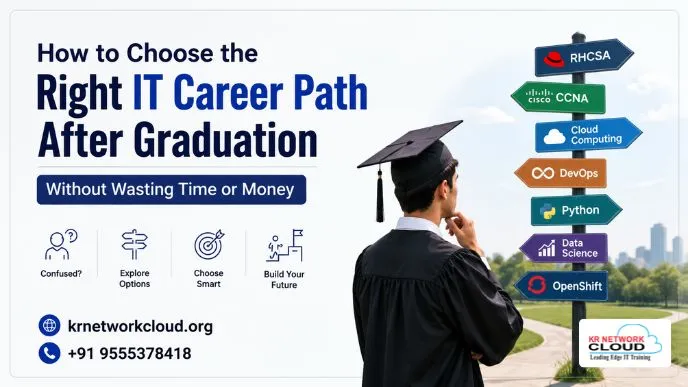
Choosing the right IT Career Path After Graduation is one of the most important decisions a fresher will make. Every year, thousands of students complete their B.Tech, BCA, MCA, M.Tech, Diploma, and other technical programs, only to find themselves confused about which technology to learn next. With so many options available, it becomes difficult to identify which path aligns with your interests, strengths, and long-term career goals.
Completing graduation is a major achievement, but for many students, it is also the beginning of a new challenge. Once the exams are over and the degree is in hand, the next question starts creating pressure:
“What should I do now?”
Some students want to enter the IT industry immediately. Others want to build technical skills before applying for jobs. Many are searching for certifications, training programs, internships, and career guidance. Unfortunately, this is also the stage where confusion reaches its highest level.
Open YouTube and one person says Cloud Computing is the future. Open LinkedIn and someone claims DevOps is the most in-demand career. Browse social media and you will find people talking about Artificial Intelligence, Cyber Security, Data Science, Automation, Kubernetes, Networking, Linux Administration, and many other technologies.
- Every technology is presented as the best option.
- Every training provider claims to have the perfect roadmap.
- Every advertisement promises career growth.
For a fresher, it becomes difficult to identify what is genuinely useful and what is simply marketing.
The reality is that there is no single technology that is perfect for everyone. A successful IT career is not built by chasing trends. It is built by choosing a path that matches your interests, strengths, learning style, and long-term goals.
This guide is designed to help students and fresh graduates make practical career decisions based on real-world requirements rather than industry hype.
| What Freshers See | Reality |
|---|---|
| Trending Technologies | Trends change quickly |
| High Salary Posts | Skills matter more than hype |
| Social Media Advice | Not every path suits everyone |
| Quick Success Stories | Most careers take consistent effort |
| Multiple Certifications | Strong fundamentals matter more |
What is the Right IT Career Path After Graduation?
Most students enter the job market with very little understanding of how the IT industry actually works.
During graduation, students are exposed to multiple subjects, but very few colleges explain how those subjects connect to real-world job roles. As a result, students know the names of technologies but do not understand where those technologies are used or how they contribute to business operations.
When a fresher starts researching career options, they immediately encounter dozens of different recommendations. One person recommends Linux. Another suggests Cloud Computing. Someone else advises learning Python. Then there are discussions about DevOps, Data Science, Networking, OpenShift, Containers, Automation, and many other technologies.
The problem is not that these technologies are bad. The problem is that they are often presented without context.
A student may hear that Kubernetes is in demand but may not understand that Kubernetes is much easier to learn after developing strong Linux fundamentals. Similarly, many students want to learn DevOps without understanding operating systems, networking concepts, scripting, or cloud platforms.
This creates a situation where students jump from one technology to another without building a solid foundation.
Another reason for confusion is the fear of making the wrong investment. Freshers are often concerned about spending money on a course that may not help them achieve their career goals. This concern is completely valid because the internet is filled with advertisements, conflicting advice, and unrealistic promises.
The good news is that career decisions become much easier when you stop focusing on what everyone else is learning and start focusing on what skills are actually required in the industry.
Don’t Choose a Technology Because It’s Trending
One of the biggest mistakes freshers make is selecting a technology simply because it is popular.
Popularity does not automatically make a technology suitable for your career goals.
A technology may become popular because companies are investing heavily in it. It may receive attention because it is generating headlines or because social media influencers are creating content around it. None of these factors guarantee that it is the right choice for you.
Many students fall into the trap of believing that the most discussed technology will automatically provide the fastest career growth. They spend months learning concepts they do not enjoy, only to discover later that the job role itself does not match their interests.
A much better approach is to understand what professionals in a particular field actually do every day.
For example, professionals working with Linux spend time managing servers, troubleshooting issues, handling user permissions, configuring storage, and maintaining system stability.
Network Engineers focus on connectivity, routing, switching, troubleshooting network problems, and ensuring reliable communication between systems.
Cloud professionals work with infrastructure, virtualization, deployment, scalability, and resource management.
DevOps professionals focus on automation, deployment processes, container technologies, infrastructure management, and operational efficiency.
Data professionals spend significant time working with data analysis, data processing, visualization, and programming.
Each role requires a different mindset and a different set of interests.
Instead of asking:
“Which technology is trending?”
Ask:
“Which type of work would I enjoy doing every day?”
That single question can prevent months of confusion and help you choose a much more suitable career path.
Understand Your Learning Style First
Before choosing any technology, it is important to understand how you naturally learn and solve problems.
Many students try to copy the career path of a friend, senior, or social media influencer without considering whether that path matches their own interests. This often leads to frustration because different people enjoy different types of work.
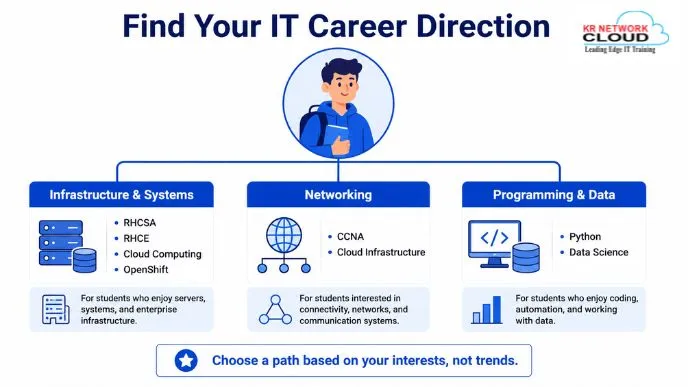
Some students enjoy working with systems and infrastructure. They like understanding how servers operate, how networks communicate, and how applications run behind the scenes. These students are often more comfortable with Linux, Networking, Cloud Computing, OpenShift, and infrastructure-related technologies.
| If You Enjoy... | Consider Learning |
|---|---|
| Servers and Infrastructure | RHCSA, RHCE, OpenShift |
| Networking and Connectivity | CCNA, Cloud Computing |
| Automation and Scripting | Python, DevOps |
| Enterprise Platforms | OpenShift, Red Hat Technologies |
| Data and Analytics | Python, Data Science |
Other students enjoy automation and problem-solving. They like writing scripts, creating workflows, and reducing manual effort. These students often find Python, Ansible, DevOps, and automation technologies more engaging.
There are also students who enjoy working with data. They are interested in extracting insights, analyzing information, and making data-driven decisions. These learners may naturally gravitate towards Python, SQL, and Data Science.
Choosing a career path that aligns with your interests makes learning significantly easier. You are more likely to stay motivated, practice consistently, and continue improving your skills over time.
A successful career is rarely built on forcing yourself to learn something you dislike. It is usually built on finding a field that keeps you curious and motivated to learn more.
Which IT Career Path Requires Less Coding?
One of the most common questions freshers ask before choosing a technology is whether coding is required.
Many students assume that every IT role requires advanced programming skills. This assumption often creates unnecessary fear and prevents students from exploring career paths that may actually suit their interests.
The reality is that the IT industry consists of multiple domains. Some roles require extensive programming, while others focus more on infrastructure, administration, troubleshooting, automation, and system management.
If you are someone who enjoys understanding how systems work, solving technical issues, configuring servers, managing infrastructure, or working with enterprise environments, there are several career paths where coding is not the primary requirement.
Linux Administration is one such example. Professionals working with Linux spend a significant amount of time managing servers, configuring storage, handling user permissions, implementing security controls, monitoring system health, and troubleshooting operational issues.
This is one of the reasons why RHCSA continues to be a strong starting point for many freshers entering the infrastructure domain. It helps students understand how enterprise operating systems function and provides a practical foundation for many advanced technologies.
Networking is another field that attracts students who prefer working with infrastructure rather than software development.
Network Engineers focus on communication between systems, routing, switching, network security, connectivity issues, and infrastructure reliability. Certifications such as CCNA help students build these foundational skills and understand how enterprise networks operate.
Cloud Computing also provides opportunities for students who are not interested in becoming software developers. While cloud environments contain programming and automation components, many cloud-related roles focus on infrastructure management, deployment, monitoring, virtualization, and platform administration.
As students gain experience, they can gradually learn scripting and automation without needing to become full-time programmers.
The important thing to understand is that “less coding” does not mean “less learning.”
Every technical role requires problem-solving skills, continuous learning, and practical experience. The difference is that your primary focus may be infrastructure, networking, or systems rather than software development.
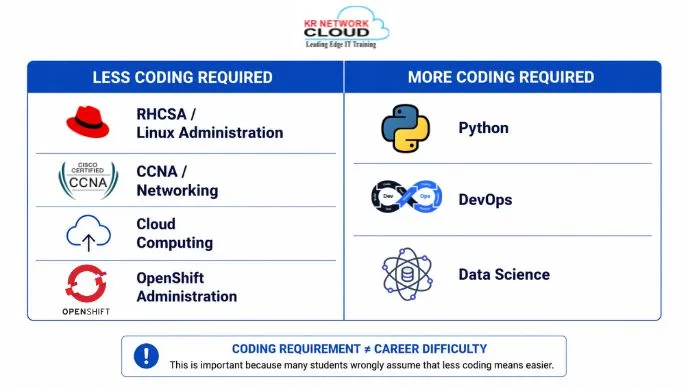
For students who enjoy working with technology but do not want to spend their entire day writing code, the following paths are often worth exploring:
- Linux Administration (RHCSA, RHCE)
- Networking (CCNA)
- Cloud Computing
- OpenShift Administration
- System Administration
- Infrastructure Operations
These paths can provide a strong foundation while allowing students to gradually develop automation skills as their careers progress.
Which IT Career Path Requires More Coding?
While some IT domains focus primarily on infrastructure and administration, others rely heavily on programming and software development.
Students who enjoy building applications, solving logical problems, creating automation scripts, and working with data often find coding-focused careers more engaging.
One of the most accessible starting points for programming is Python.
Python has become popular because it is relatively easy to learn compared to many other programming languages. It is used across multiple domains, including automation, cloud operations, data analysis, scripting, and software development.
For freshers, learning Python can provide a strong understanding of programming concepts while also opening doors to multiple career paths.
Data Science is another field where programming plays a significant role. Professionals working with data often use programming languages to process information, automate analysis, create visualizations, and build analytical models.
Students entering this field should enjoy working with data, solving analytical problems, and continuously learning new tools and techniques.
Automation is another area where coding becomes increasingly valuable.
As organizations grow, they look for ways to reduce manual tasks and improve operational efficiency. Professionals who can automate repetitive activities often become valuable contributors to their teams.
This is one reason why technologies such as Python, Ansible, and DevOps tools have gained significant attention in modern IT environments.
However, students should avoid viewing coding as a barrier.
Programming is a skill that improves with practice.
Many professionals who work in automation, DevOps, cloud operations, and data-related roles started with little or no programming experience. Over time, they developed their skills through hands-on practice and real-world projects.
The key is not whether coding is difficult.
The key is whether you enjoy solving problems through logic and automation.
If the answer is yes, then programming-focused career paths may be an excellent choice for you.
| Career Path | Coding Requirement | Learning Difficulty |
|---|---|---|
| RHCSA / Linux Administration | Low | Moderate |
| CCNA / Networking | Low | Moderate |
| Cloud Computing | Low to Moderate | Moderate |
| OpenShift Administration | Moderate | Moderate |
| DevOps | Moderate | High |
| Python Development | High | Moderate |
| Data Science | High | High |
The Importance of Building Strong Fundamentals
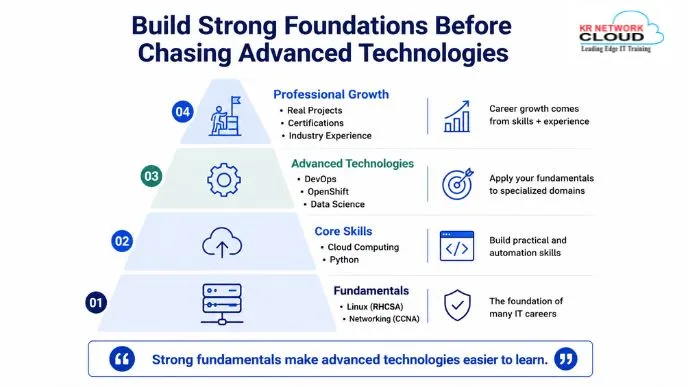
One of the biggest mistakes freshers make is trying to learn advanced technologies before understanding the fundamentals.
The IT industry is full of students who know the names of modern technologies but struggle to explain how the underlying systems actually work.
This approach creates knowledge gaps that become difficult to overcome later.
For example, many students want to learn Kubernetes because they hear it is widely used in modern infrastructure environments.
What they often do not realize is that Kubernetes becomes significantly easier to understand when you already know Linux, networking, storage concepts, and basic system administration.
Similarly, students frequently want to learn DevOps without first understanding operating systems, scripting, cloud infrastructure, and application deployment.
The result is predictable.
They memorize commands without understanding why those commands exist.
Strong careers are built on strong foundations.
Think of your career as a building.
The technologies you learn later represent the upper floors.
Your fundamentals represent the foundation.
If the foundation is weak, every advanced technology becomes more difficult to learn.
For most freshers, the strongest foundations usually include:
Linux Fundamentals
Linux remains one of the most important technologies in enterprise environments. Understanding Linux helps students develop practical administration skills and creates a foundation for cloud computing, DevOps, OpenShift, automation, and many advanced technologies.
Networking Fundamentals
Every application, server, cloud platform, and enterprise system depends on networking.
Students who understand IP addressing, DNS, routing, switching, and connectivity concepts often find it easier to troubleshoot issues and understand larger infrastructure environments.
Cloud Fundamentals
Cloud computing has transformed the way organizations deploy and manage infrastructure.
Learning cloud concepts helps students understand scalability, virtualization, deployment models, resource management, and modern infrastructure practices.
Automation Fundamentals
Automation is becoming increasingly important across multiple domains.
Understanding scripting and automation concepts allows students to reduce manual work and manage infrastructure more efficiently.
Problem-Solving Skills
Technology changes continuously.
The ability to troubleshoot, investigate, and solve problems often becomes more valuable than memorizing specific tools or commands.
Students who focus on building strong fundamentals create a learning framework that supports every advanced technology they choose to pursue in the future.
| Career Path | Best For | Foundation Required | Long-Term Growth |
|---|---|---|---|
| RHCSA & Linux | Infrastructure Enthusiasts | Linux Fundamentals | Excellent |
| CCNA | Networking Enthusiasts | Networking Concepts | Excellent |
| Cloud Computing | Infrastructure & Operations | Linux + Networking | Excellent |
| DevOps | Automation Lovers | Linux + Python | Excellent |
| Python | Programming Enthusiasts | Programming Logic | Excellent |
| Data Science | Analytical Thinkers | Python + Data Skills | Excellent |
| OpenShift | Enterprise Platform Administration | Linux + Containers | Excellent |
A Practical Learning Roadmap for Freshers
One of the biggest reasons students struggle in the IT industry is that they try to learn everything at the same time.
They start with Cloud Computing today, switch to DevOps next month, watch a few videos about Data Science, then suddenly begin learning Networking because someone told them it has good opportunities.
After several months, they have touched multiple technologies but mastered none of them.
The IT industry rewards depth much more than random knowledge.
This does not mean you should only learn one technology forever. It means you should follow a structured learning path where each skill supports the next skill.
Think of your career as building a house.
You do not start with the roof.
You start with a strong foundation.
The same principle applies to technology careers.
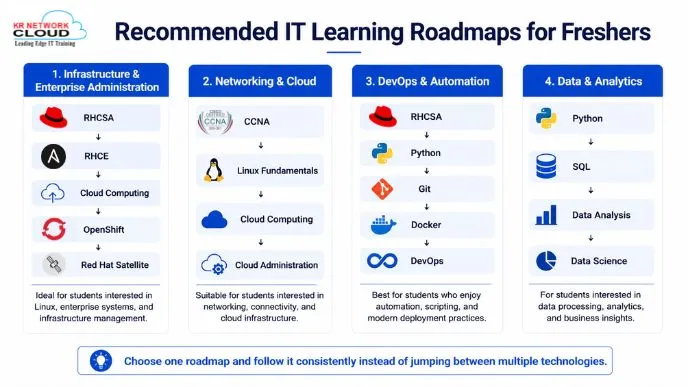
Roadmap 1: Infrastructure and Enterprise Administration
Infrastructure roadmap is suitable for students who enjoy systems, troubleshooting, servers, enterprise environments, and infrastructure management.
A recommended progression would be:
RHCSA → RHCE → Cloud Computing → OpenShift → Red Hat Satellite → Enterprise Automation
This path develops strong Linux administration skills first and then gradually introduces cloud technologies and enterprise platform management.
Many students attempt to learn OpenShift or cloud platforms directly. However, professionals who understand Linux administration often learn these technologies faster because they already understand the underlying systems.
Roadmap 2: Networking and Cloud Infrastructure
Network roadmap is ideal for students who enjoy connectivity, communication systems, troubleshooting, and infrastructure design.
A recommended progression would be:
CCNA → Linux Fundamentals → Cloud Computing → Cloud Administration → Infrastructure Automation
Networking remains one of the most important foundations in IT.
Every application, cloud platform, virtual machine, container, and enterprise service depends on networking.
Students who understand networking concepts often find troubleshooting much easier throughout their careers.
Roadmap 3: DevOps and Automation
DevOps roadmap is suitable for students who enjoy automation, efficiency, scripting, and modern infrastructure practices.
A recommended progression would be:
RHCSA → Python → Git → Docker → Kubernetes → DevOps Tools → Infrastructure Automation
Many freshers make the mistake of starting directly with DevOps tools.
The problem is that DevOps is not a single technology.
It is a combination of operating systems, automation, version control, containers, cloud concepts, and deployment practices.
Students who build a strong Linux and Python foundation usually progress much more smoothly in DevOps environments.
Roadmap 4: Data and Analytics
Students who enjoy working with information, patterns, reports, and business insights often find this path interesting.
A recommended progression would be:
Python → SQL → Data Analysis → Data Visualization → Data Science
The goal here should not be learning every tool available.
The goal should be understanding how to work with data and solve business problems through analysis and interpretation.
| Career Goal | Recommended Learning Path |
|---|---|
| Linux Administrator | RHCSA → RHCE |
| Network Engineer | CCNA → Linux Fundamentals |
| Cloud Engineer | RHCSA → Cloud Computing |
| DevOps Engineer | RHCSA → Python → DevOps |
| OpenShift Administrator | RHCSA → Containers → OpenShift |
| Data Professional | Python → Data Science |
Don’t Rush the Process
Many students want to complete an entire career roadmap within a few weeks.
This mindset often creates frustration.
Technology careers are built through continuous learning, hands-on practice, projects, troubleshooting, and real-world exposure.
The students who succeed are usually not the ones who learn the fastest.
They are the ones who remain consistent over time.
How to Evaluate a Training Institute
Choosing the right learning path is important.
Choosing the right training environment is equally important.
Many students spend considerable time researching technologies but very little time evaluating where they will actually learn those technologies.
This often leads to disappointment.
Before enrolling in any program, focus on the learning experience rather than marketing promises.
A good training institute should help students develop practical skills, not just complete a syllabus.
Contact for Free Career Guidance: KR Network Cloud Technologies
Look for Practical Training
Technology cannot be learned effectively through theory alone.
Students should have access to practical exercises, lab environments, assignments, and hands-on activities.
The more practical exposure you receive, the more confident you become when working with real systems.
Evaluate Trainer Experience
The quality of training often depends on the quality of the instructor.
Look for trainers who have worked with the technologies they teach.
Real-world experience allows instructors to explain concepts beyond what is available in textbooks.
Experienced trainers can also share troubleshooting methods, industry practices, and practical insights that are difficult to learn independently.
| Question | Why It Matters |
|---|---|
| Are practical labs included? | Practical skills build confidence |
| Is trainer experienced? | Real-world knowledge matters |
| Are sessions recorded? | Helps revision and flexibility |
| Is there a learning roadmap? | Prevents confusion |
| Is interview guidance available? | Helps career preparation |
| Is there community support? | Continuous learning |
Check the Learning Roadmap
Many students enroll in courses without understanding where those courses fit into their long-term career plans.
Before joining any program, ask:
- What role does this course prepare me for?
- What should I learn after completing it?
- What prerequisite knowledge is required?
A good training provider should be able to answer these questions clearly.
Focus on Skills, Not Just Certificates
Certifications are valuable because they validate skills.
However, certifications alone do not build careers.
Employers generally care more about whether candidates can perform tasks, solve problems, and contribute effectively.
The most valuable training programs combine certification preparation with practical skill development.
Look for Long-Term Support
Learning does not stop when a course ends.
Students often require additional guidance while practicing, preparing for interviews, or working on projects.
Strong learning communities, mentoring opportunities, doubt-clearing sessions, and support systems can make a significant difference in long-term success.
Questions to Ask Before Spending Money on Any Course
Before investing in any technology training, ask yourself a few important questions.
These questions can help prevent poor decisions and ensure that your investment aligns with your goals.
Why do I want to learn this technology?
- Be honest with yourself.
- Are you learning it because you are genuinely interested?
- Or are you learning it because everyone else seems to be doing it?
- The answer matters more than most students realize.
What job roles does this technology support?
- Every technology serves a purpose.
- Understanding the job roles associated with a technology helps you evaluate whether it matches your career goals.
What are the prerequisites?
- Some technologies are beginner-friendly.
- Others require foundational knowledge.
- Knowing the prerequisites helps you create realistic expectations and avoid frustration.
How much practical work is included?
- Theoretical understanding is important.
- Practical experience is essential.
- Always understand how much hands-on learning is included in the program.
What comes after this course?
- Technology learning should feel like a roadmap, not a collection of disconnected courses.
- Understanding the next step helps you create a long-term learning strategy.
Final Decision Framework
If you are still confused after reading this guide, connect with our industry experts directly on call +91 9555378418 for career guidance instead of randomly searching over internet or simplify the decision-making process.
Instead of asking:
“What is the best technology?”
Ask:
“What type of work do I want to do every day?”
- If you enjoy infrastructure, systems, and enterprise environments, consider Linux, Networking, Cloud Computing, OpenShift, and enterprise administration technologies.
- If you enjoy automation and scripting, consider Python, DevOps, and infrastructure automation.
- If you enjoy data and analysis, consider Python, SQL, and Data Science.
The best technology is rarely the one generating the most online discussion.
The best technology is the one that aligns with your interests, strengths, and long-term goals.
Technology trends will continue to change.
- New tools will emerge.
- New platforms will be introduced.
- New buzzwords will dominate social media.
However, professionals who build strong fundamentals, develop practical skills, and remain committed to continuous learning consistently create opportunities for themselves regardless of market trends.
Your goal should not be to chase every new technology.
Your goal should be to build a strong foundation and then grow steadily from there.
A well-planned career path may take longer to build, but it usually creates far more sustainable results than constantly jumping from one trend to another.
| If You Want To... | Start With |
|---|---|
| Work with Linux Servers | RHCSA |
| Build Networking Skills | CCNA |
| Learn Cloud Technologies | RHCSA + Cloud Computing |
| Work in Enterprise Platforms | RHCSA + OpenShift |
| Learn Automation | Python |
| Become a DevOps Engineer | RHCSA + Python + DevOps |
| Work with Data | Python + Data Science |
Conclusion
The IT industry offers tremendous opportunities for students willing to learn and grow.
The challenge is not finding a technology.
The challenge is finding the right direction.
Take the time to understand your interests, identify your strengths, evaluate your options carefully, and build your skills step by step.
Whether you choose Linux Administration, Networking, Cloud Computing, DevOps, Python, Data Science, OpenShift, or advanced Red Hat technologies, remember that success is rarely determined by the technology itself.
It is determined by the consistency, effort, and practical experience you develop along the way.
The right career path is not the one that everyone else is following.
The right career path is the one that helps you build a sustainable future while continuously growing your skills and confidence as a technology professional.
Frequently Asked Questions About Choosing an IT Career After Graduation
Which IT course should I choose after graduation?
There is no single best IT course for every student. The right choice depends on your interests and career goals. Students interested in infrastructure can start with RHCSA or CCNA, while those interested in automation and programming can begin with Python. Cloud Computing, DevOps, OpenShift, and Data Science can be pursued after building strong fundamentals.
Which IT career is best for freshers?
There is no single IT career that is best for every fresher.
The right career depends on your interests, strengths, and the type of work you enjoy doing. Some students enjoy working with servers and infrastructure, while others enjoy networking, automation, programming, or data analysis.
Instead of looking for the “best” technology, focus on identifying the field that matches your learning style and long-term goals.
For many beginners, Linux Administration, Networking, Cloud Computing, Python, DevOps, and Data Science are excellent starting points because they provide strong foundations and multiple growth opportunities.
Which technology should I learn first after graduation?
Before choosing any advanced technology, focus on building fundamentals.
For students interested in infrastructure and enterprise technologies, Linux and Networking are often excellent starting points.
For students interested in programming and automation, Python is a strong first choice because it is beginner-friendly and widely used across multiple domains.
The first technology should not be selected based on trends. It should be selected based on the direction you want your career to take.
Is Linux still a good career option?
Yes.
Linux continues to be one of the most important technologies in enterprise environments.
Many cloud platforms, enterprise servers, container platforms, and modern infrastructure environments rely heavily on Linux.
Students who build strong Linux administration skills often find it easier to progress into Cloud Computing, OpenShift, DevOps, Kubernetes, Automation, and enterprise infrastructure roles.
Linux is not just another technology.
It is a foundation that supports many modern IT careers.
Is RHCSA worth learning for freshers?
RHCSA is often considered one of the strongest starting points for students interested in system administration, infrastructure management, cloud technologies, and enterprise Linux environments.
The certification focuses on practical administration skills rather than theoretical concepts.
Students who complete RHCSA preparation usually gain exposure to user management, storage management, networking, security, troubleshooting, and system administration tasks that are commonly performed in enterprise environments.
Should I learn CCNA or RHCSA first?
The answer depends on your interests.
If you are interested in servers, operating systems, cloud platforms, and enterprise infrastructure, RHCSA is usually a logical starting point.
If you enjoy networking concepts, troubleshooting connectivity issues, routing, switching, and communication systems, CCNA may be more suitable.
Both technologies complement each other and provide valuable foundational knowledge.
Is Cloud Computing suitable for beginners?
Yes, but students should understand that Cloud Computing becomes easier when supported by strong fundamentals.
Cloud platforms involve operating systems, networking, virtualization, storage, security, and infrastructure concepts.
Students who understand Linux and Networking often learn cloud technologies more effectively because they already understand many of the underlying concepts.
Can I learn DevOps directly after graduation?
Many students try to start directly with DevOps because they hear about its popularity.
However, DevOps is not a single technology.
It combines operating systems, scripting, automation, version control, containers, cloud platforms, monitoring, and deployment practices.
Students who first develop skills in Linux, Python, and cloud concepts generally find DevOps easier to understand.
Is Python necessary in IT?
Python is useful across multiple domains.
It is used for automation, scripting, cloud operations, DevOps, data analysis, software development, and many other applications.
Even students who do not plan to become software developers can benefit from learning Python because it helps automate repetitive tasks and improve problem-solving skills.
Is Data Science a good option for freshers?
Data Science can be an excellent option for students who enjoy working with data, analysis, statistics, and problem-solving.
However, students should understand that Data Science requires consistent learning and often involves programming, data processing, and analytical thinking.
Choosing Data Science simply because it is popular is not recommended.
Choose it because you genuinely enjoy working with data.
How do I know which technology suits me?
The easiest way is to understand the type of work you enjoy.
Ask yourself:
Do I enjoy working with systems and infrastructure?
Do I enjoy troubleshooting technical problems?
Do I enjoy programming and automation?
Do I enjoy analyzing information and finding patterns?
Your answers will usually point you toward the technologies that best match your interests.
Should I focus on certifications or skills?
Skills should always be the primary focus.
Certifications are valuable because they validate knowledge and demonstrate commitment to learning.
However, certifications become far more powerful when supported by practical skills and hands-on experience.
The ideal approach is to build skills while preparing for certifications.
How important are practical labs?
Practical experience is one of the most important aspects of technical learning.
Reading documentation and watching videos can help you understand concepts, but practical labs help you develop confidence.
The more hands-on experience you gain, the more prepared you become for real-world environments.
How long does it take to build an IT career?
There is no fixed timeline.
Some students progress quickly because they practice consistently and follow a structured learning path.
Others take longer because they are balancing studies, jobs, or other responsibilities.
Instead of comparing your progress with others, focus on building skills consistently.
Small improvements over time often create significant results.
Can I build an IT career without a Computer Science degree?
Yes.
Many successful professionals come from different educational backgrounds.
What matters most is your willingness to learn, practice, solve problems, and continuously improve your skills.
Employers often value practical skills and technical competence more than specific degree titles.
What is the biggest mistake freshers make?
The biggest mistake is constantly changing direction.
Many students spend months moving between different technologies without mastering any of them.
They start one course, switch to another, follow a new trend, and repeat the process.
Successful professionals usually follow a structured roadmap and remain committed to it long enough to develop meaningful skills.
What should I focus on during my first year of learning?
Your first year should focus on fundamentals.
Learn the basics thoroughly.
Understand operating systems, networking concepts, cloud fundamentals, scripting, and problem-solving techniques.
Strong fundamentals make every advanced technology easier to learn later.
Final Thoughts
The IT industry offers tremendous opportunities for students who are willing to learn and grow. The challenge is not finding a technology to learn. The challenge is choosing a direction and remaining committed to it long enough to build real skills.
Do not allow trends, social media hype, or marketing promises to make your career decisions for you.
Take the time to understand your interests, evaluate your options carefully, and build a strong foundation.
Whether your journey begins with RHCSA, CCNA, Cloud Computing, Python, DevOps, Data Science, OpenShift, or advanced Red Hat technologies, remember that long-term success comes from practical skills, consistent effort, and continuous learning.
The students who build strong foundations today are often the professionals leading enterprise projects tomorrow.
Choose wisely, learn consistently, and focus on becoming genuinely skilled rather than simply collecting certificates.