AI Engineer Roadmap 2026
- KR NETWORK CLOUD
- October 23, 2026
AI Engineer Roadmap 2026: Skills to Learn Step by Step
Artificial intelligence is moving beyond model development. Companies now need engineers who can connect AI models with applications, databases, APIs and cloud infrastructure. That is where AI engineering comes in.
If you want to become an AI Engineer in 2026, learning random AI tools is not enough. You need a clear learning path that starts with programming and data fundamentals, then moves into machine learning, deep learning, LLMs, RAG, AI agents and production systems.
This AI Engineer roadmap explains what to learn, in what order, and what you should be able to build at each stage.
What Does an AI Engineer Do?
An AI Engineer builds software that uses artificial intelligence to solve practical problems.
For example, an AI Engineer may build a customer-support assistant, a document search system, an AI-powered recommendation system or an agent that can use external tools to complete tasks.
The role combines software engineering with AI and machine learning. Current job postings in India commonly mention Python, cloud platforms, LLMs, SQL, Docker, CI/CD, RAG and MLOps. One analysis of 46 Indian AI Engineer postings from July to September 2026 found Python in 71% of the companies surveyed, AWS in 52%, LLMs in 38%, SQL and Docker in 33% each, and RAG in 29%. These figures describe that specific sample rather than the entire job market.
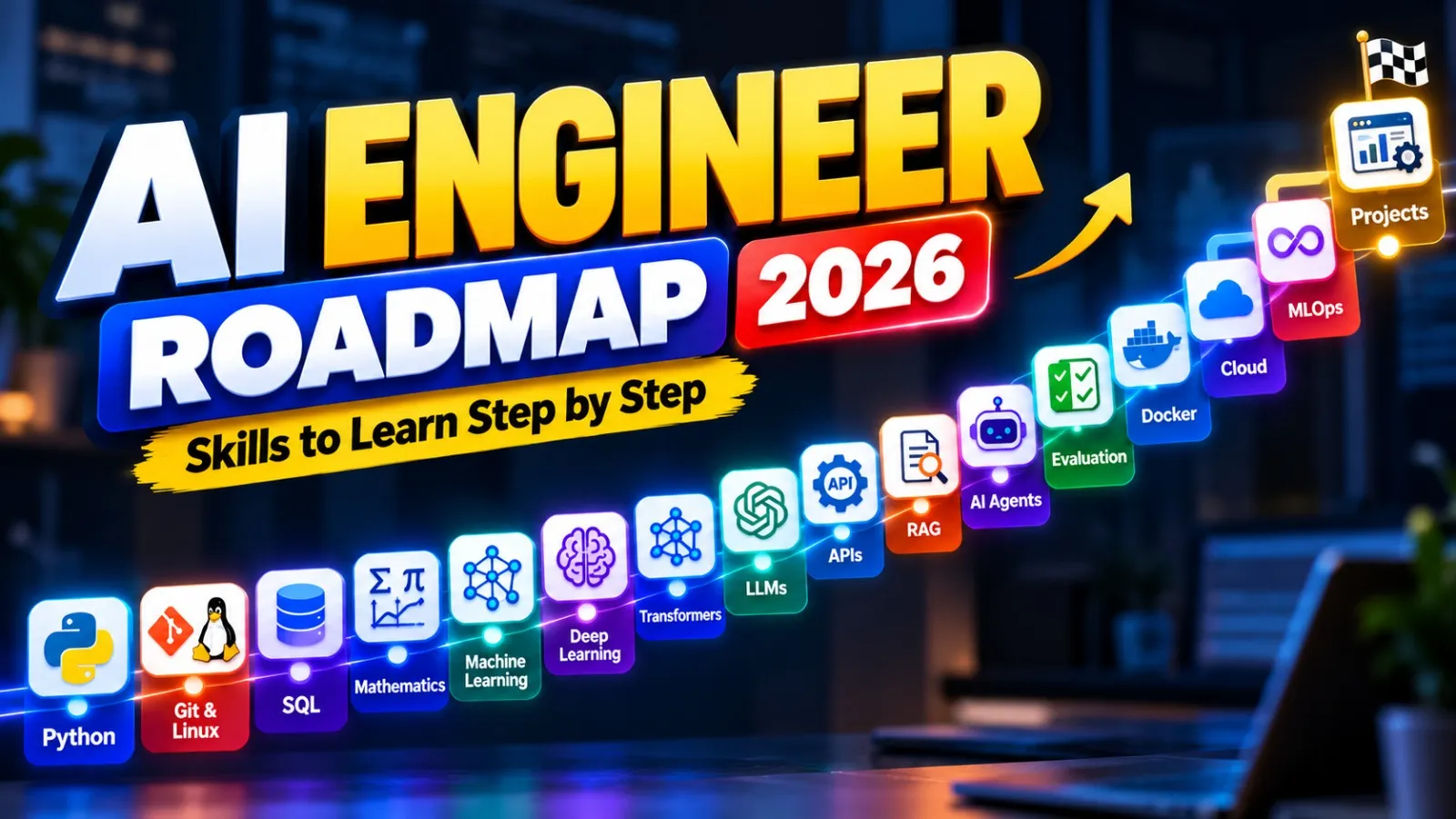
AI Engineer Roadmap 2026
A practical learning sequence is:
Python → Git & Linux → SQL → Mathematics → Machine Learning → Deep Learning → Transformers → LLMs → APIs → RAG → AI Agents → Evaluation → Docker → Cloud → MLOps → Projects
You do not have to become an expert in every area before moving forward. The goal is to build enough knowledge at each stage to understand the next one.
1. Learn Python First
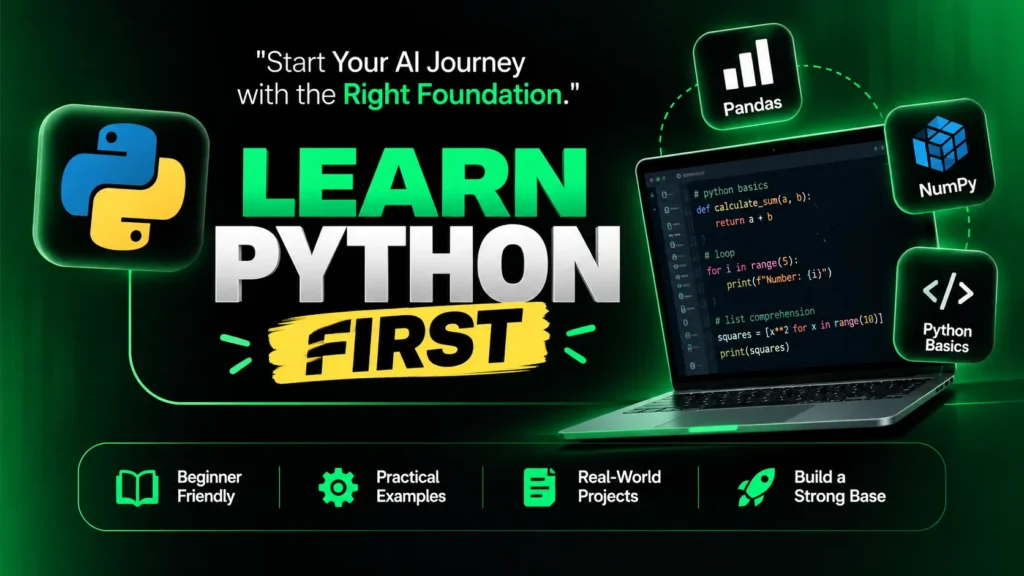
Python is the most useful programming language for AI engineering. Current AI Engineer and ML Engineer job-posting samples continue to place Python near the top of their requirements.
Start with variables, data types, conditions, loops, functions and modules. Then learn object-oriented programming, exception handling, file operations and virtual environments.
Once you have the basics, learn libraries such as NumPy and Pandas. You should also become comfortable working with JSON and making basic API requests.
Your first projects can be simple: a data-processing script, an API client or a small Python application.
2. Learn Git and Linux
AI applications eventually need to run on servers and cloud platforms. Basic Linux and Git knowledge will make that work much easier.
Learn Git commands, branches, commits and GitHub. For Linux, focus on the command line, files and directories, permissions, processes, environment variables and package management.
You do not need to become a Linux administrator. You need enough knowledge to work comfortably in a development and deployment environment.
3. Learn SQL
AI applications often work with business data stored in databases.
Learn SELECT queries, filtering, joins, grouping, aggregation, subqueries and basic database design. Later, move into window functions and more advanced SQL.
SQL is still relevant in modern AI roles. A September 2026 analysis of Indian AI Engineer postings found SQL in 33% of the companies in its sample.
4. Learn Mathematics and Statistics
You do not need advanced mathematics to start building AI applications, but a working understanding of mathematics becomes useful as you move deeper into machine learning.
Focus on:
- Linear algebra
- Probability
- Statistics
- Basic calculus
Pay particular attention to vectors, matrices, probability distributions, averages, variance, derivatives and optimization.
The goal is understanding, not memorizing formulas.
5. Learn Machine Learning
Before moving deeply into modern AI, understand the basic ideas behind machine learning.
Learn supervised and unsupervised learning, regression, classification, clustering, feature engineering, training and testing, overfitting and model evaluation.
Start with scikit-learn and build a few small projects.
For example, you could build a customer churn prediction model or a classification system. The project should teach you how data moves from preprocessing to training, evaluation and prediction.
6. Learn Deep Learning
Next, learn how neural networks work.
Study neural networks, activation functions, loss functions, backpropagation and optimizers. Then learn concepts such as CNNs and sequence models before moving toward transformers.
PyTorch is a useful framework to learn at this stage. Current ML Engineer job-posting data also shows strong demand for PyTorch alongside Python, cloud and LLM skills.
7. Understand Transformers
Transformers are central to modern language models.
You should understand tokens, embeddings, attention, self-attention, context and the basic difference between encoder and decoder architectures.
You do not need to implement a large transformer from scratch. You need enough understanding to know what happens between an input and a model’s output.
This knowledge makes LLM concepts much easier to understand.
8. Learn LLMs and Generative AI
Now move into large language models.
Learn how to work with model APIs, prompts, system instructions, structured outputs, tokens, context windows, embeddings and tool calling.
Build simple applications first. For example, create an AI assistant that extracts information from text or classifies customer messages.
Modern AI engineering roadmaps increasingly place LLM applications, structured outputs and tool use near the center of the learning path.
9. Learn APIs and Backend Development
An AI Engineer needs more than the ability to send a prompt to an AI model.
Learn HTTP, REST APIs, JSON, authentication and basic backend development. FastAPI is a useful Python framework for building AI services.
At this stage, build an application that exposes an AI feature through an API.
This is also where software engineering becomes increasingly important. Recent Indian AI job postings include Python, FastAPI, REST APIs, Docker, CI/CD and cloud deployment among their requirements.
10. Learn RAG
Retrieval-Augmented Generation, or RAG, allows an AI application to retrieve relevant information before generating an answer.
A basic RAG system works like this:
Documents → Chunking → Embeddings → Vector Database → Retrieval → LLM → Answer
Learn document processing, chunking, embeddings, vector databases, metadata filtering and retrieval.
Then build a document-question-answering application that can answer questions from PDFs or company documents and provide sources.
RAG is already appearing in current AI Engineer job requirements, along with vector databases and LLM applications.
11. Learn AI Agents
After understanding LLMs and RAG, learn how AI agents use tools and perform multi-step tasks.
Learn function calling, tool use, workflows, memory and agent orchestration.
For a project, build an AI research assistant that can use tools to gather information, process it and produce a structured result.
Do not assume every AI application needs an agent. A normal workflow can often be simpler and more reliable.
12. Learn AI Evaluation
A working AI application is not automatically a good AI application.
Learn how to test AI responses, measure retrieval quality, detect incorrect answers and create test datasets.
Evaluation is receiving more attention in current AI engineering roadmaps because AI systems can change behavior when prompts, models or retrieved information change.
13. Learn Docker, Cloud and MLOps
Once your application works locally, learn how to run it reliably.
Start with Docker. Learn images, containers, Dockerfiles, environment variables and Docker Compose.
Then choose one cloud platform, such as AWS, Azure or Google Cloud. You do not need to learn all three initially.
Finally, learn basic MLOps and production practices: CI/CD, logging, monitoring, model or prompt versioning, security and cost monitoring.
Current Indian AI Engineer postings frequently combine AI skills with cloud, Docker, CI/CD and MLOps.
14. Build Projects Throughout the Roadmap
Projects should not be left until the very end.
Start small and increase the difficulty as your skills improve.
You could build a Python automation tool first, followed by an ML prediction model, an LLM-powered application, a PDF-based RAG system and finally a tool-using AI agent.
Your final portfolio project should combine several skills: Python, APIs, an LLM, RAG or agents, a database, Docker and cloud deployment.
This gives employers something concrete to evaluate instead of a list of completed courses.
How Long Does It Take to Become an AI Engineer?
There is no fixed timeline because your starting point matters.
Someone who already knows Python and backend development can progress much faster than someone starting programming from zero. Current roadmaps give different estimates, ranging from several months for developers with existing programming skills to roughly 8–12 months for beginners following a structured path.
The better goal is not to finish a roadmap as quickly as possible. It is to reach the point where you can design, build, test and deploy useful AI applications.
Final Thoughts
The AI Engineer role is changing quickly, but the core learning path is becoming clearer.
Start with Python, Git, Linux and SQL. Build your understanding of mathematics, machine learning and deep learning. Then move into transformers, LLMs, APIs, RAG and AI agents.
After that, focus on evaluation, Docker, cloud and MLOps so you can take an AI application beyond a local experiment.
Most importantly, build projects as you learn. A strong AI Engineer portfolio should show that you can turn an AI model into a working software system, not simply that you have completed a list of courses.