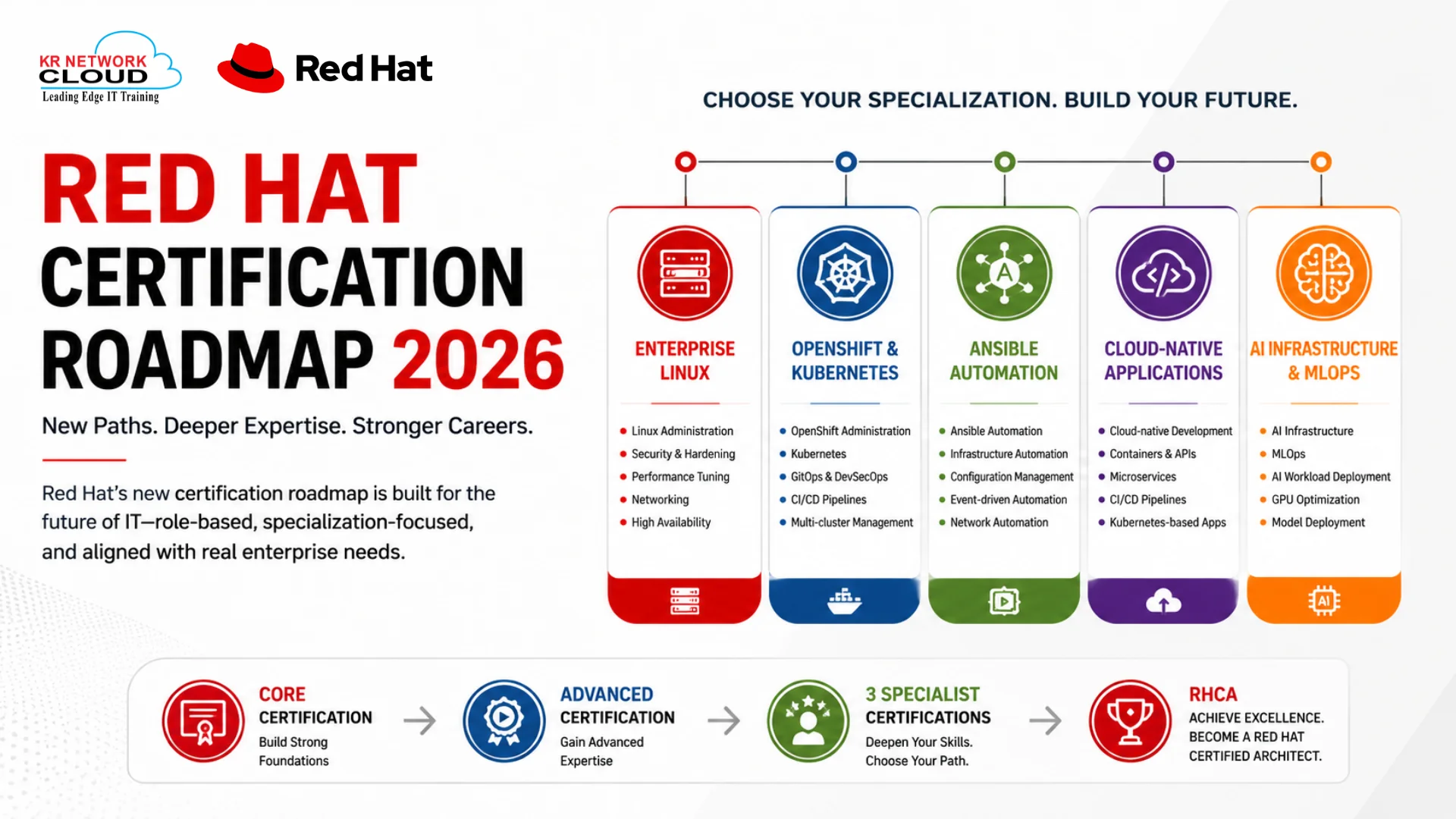
Complete Guide to OpenShift: Platforms, Roadmaps, and Certifications
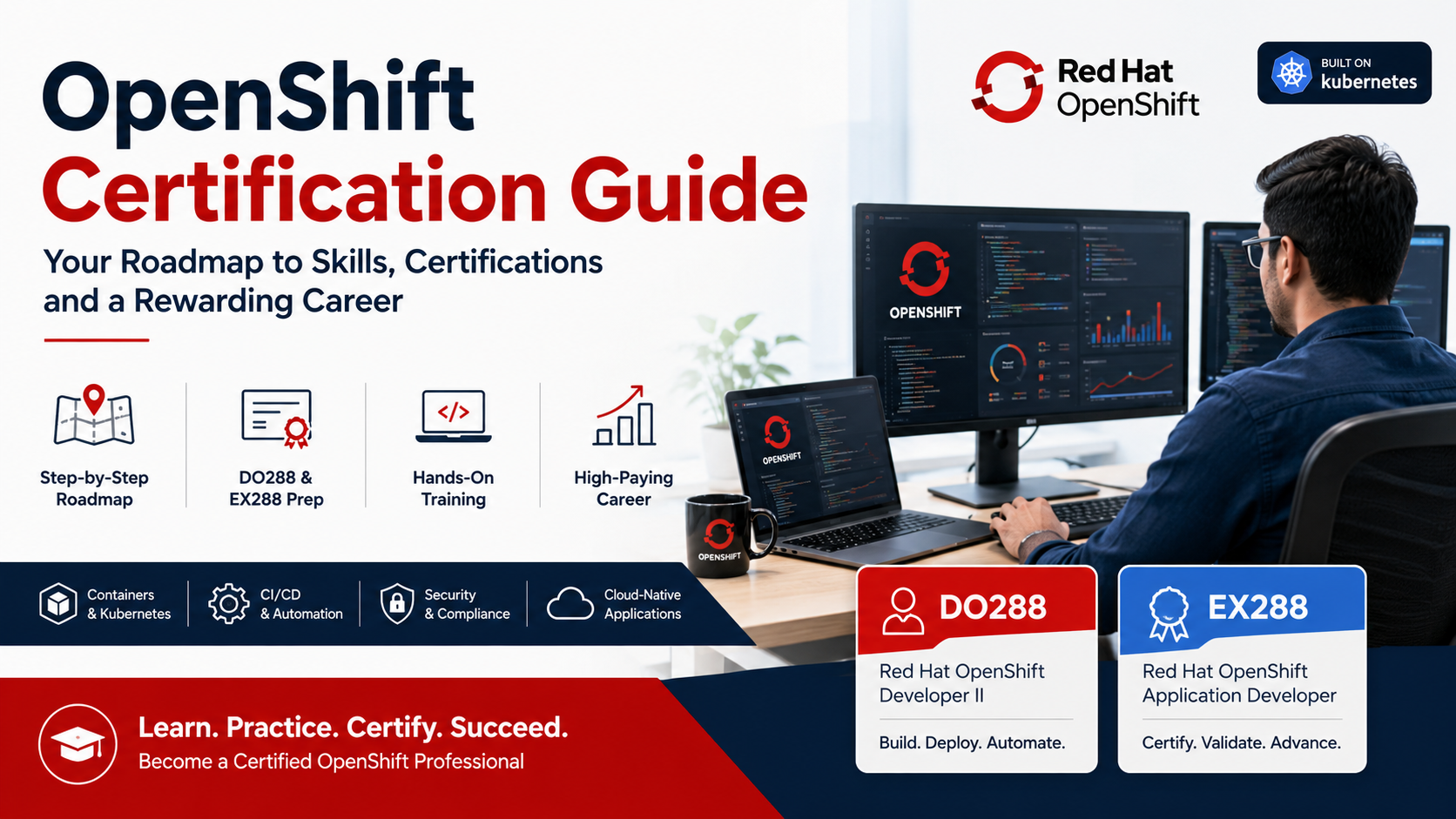
- KR NETWORK CLOUD
- June 18, 2026
What is Red Hat OpenShift and what is it used for?
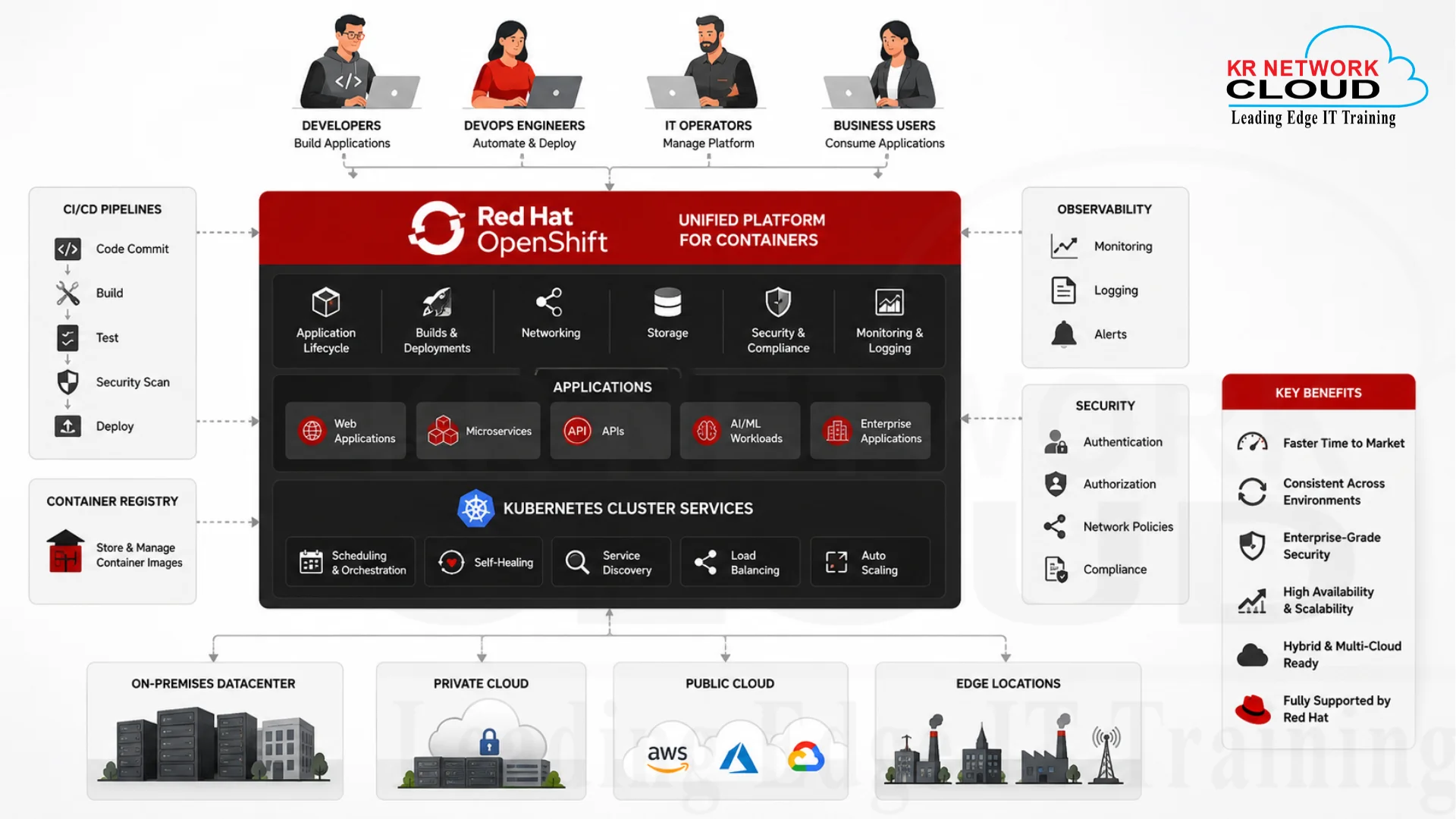
Red Hat OpenShift is a platform that allows organizations to develop, deploy, and manage applications using a common framework. It is based on Kubernetes and helps in the scaling of applications. If you want to learn OpenShift, it is essential to understand that it essentially allows organizations to run their applications inside of containers without the need to build a container orchestration layer and many other things.
It is a combination of many things including, but not limited to, Kubernetes, CI/CD, container management, and many features pertaining to security and developer tools. This robust architecture is why professionals seek structured OpenShift Training and an OpenShift Course to master it. OpenShift can be used in many ways including the deployment of ML applications, web applications, APIs, enterprise applications, and cloud-native applications. OpenShift Container Platform is the self-managed deployment of OpenShift and is managed by the organization on their own infrastructure.
It also has its certification – OpenShift Certification (EX280, EX288) discussed below if you read the complete article
Why do companies use OpenShift Certification?
Using OpenShift allows companies to consistently deploy their applications and reduces the overhead and effort in managing their applications. OpenShift provides a layer of consistency and addresses the issue of a deployment working on a developer’s workstation but failing in QA or production.
Using OpenShift, companies are able to:
- Quickly deploy applications
- Automatically scale applications
- Enable security controls
- Eliminate server management
- Standardize deployment
- Simplify update and maintenance
OpenShift is built to simplify the infrastructure for a developer. Developers now have more time to build and develop applications, since they don’t have to worry about configuring servers and networking. Real-time studies show that OpenShift helps move applications to production faster. This immense enterprise value explains why an OpenShift Developer Career is highly lucrative.
Is OpenShift a Kubernetes platform?
OpenShift is a Kubernetes platform. Kubernetes runs and manages containers, and OpenShift sits on top of Kubernetes and provides other enterprise features. The relationship between both can be described as:
Kubernetes provides the engine
OpenShift provides the complete vehicle
OpenShift builds on Kubernetes and provides:
- Dev friendly tools
- Security controls
- Image registry
- CI/CD features
- Integrations for monitoring and logging
- Easy management of clusters
- Red Hat Enterprise support
While every OpenShift cluster is a Kubernetes cluster, additional OpenShift features aren’t necessarily provided by every Kubernetes cluster. For those exploring an OpenShift Training for Beginners program or general OpenShift for Beginners resources, understanding this upstream relationship is key.
Is OpenShift still relevant in 2026? / Should I Learn OpenShift in 2026?
OpenShift is highly relevant in 2026. Modernizing applications, adopting containers, and DevOps, as well as moving to hybrid and multi-cloud, are all being done by many organizations. OpenShift has all of these features in one platform. If you are wondering, “Is OpenShift Worth Learning?” or asking yourself “Should I Learn OpenShift in 2026?”, the market demand provides a clear answer.
Some of the organizations using OpenShift still today are large enterprises, government organizations, banks, telecom companies, as well as many healthcare and technology providers. OpenShift is still used by all of these companies because of the enterprise security and support, compliance, and operational stability.
OpenShift is evolving from traditional application hosting. The newer versions support:
- AI and ML workloads
- Platforms based on Kubernetes
- Automation and GitOps
- Engineering platforms
- Hybrid cloud deployments
- Edge computing environments
For OpenShift professionals who get their Openshift certification completed, their OpenShift skills will continue to be in demand, as organizations need engineers to build, deploy, secure, and manage containerized applications at scale. As long as the need for Kubernetes remains within the industry, so will the need for OpenShift within enterprise environments. This stability makes establishing an OpenShift Career Path an excellent long-term move.
OpenShift vs Kubernetes: What should you study?
Kubernetes and OpenShift should be studied together. Kubernetes is the container orchestration layer and OpenShift is built on top of Kubernetes and provides a collection of tools around security, monitoring, CI/CD, and the developer experience.
Kubernetes is the first step for beginners. Start by learning the basic concepts of Kubernetes. Then learn OpenShift to see an example of Kubernetes in a corporate environment, which serves as the perfect OpenShift Learning Path. OpenShift has a different level of complexity compared to Kubernetes. OpenShift has a lot of opinionated and pre-configured features compared to its upstream layer. You can learn OpenShift without in-depth knowledge of Kubernetes, but learning the fundamentals of Kubernetes is essential.
What is the difference between OpenShift and Docker?
Docker and OpenShift are designed for different tasks. Docker is used to package and ship applications as containers. OpenShift provides the orchestration, security, and scaling across a fleet of servers for packaged containers.
One way to think of it is:
- Docker is used to build the container.
- OpenShift is used to run and orchestrate the container.
That is why many businesses use Docker to build their applications and OpenShift to run them.
Why is OpenShift favored by enterprises?
OpenShift is a container platform compared to Kubernetes, which is an orchestration platform.
Benefits to Organizations:
- Speed app deployment
- Enhance protection
- Streamline processes
- Eliminate manual work
- Receive Red Hat’s enterprise assistance
For large enterprises the biggest benefit from OpenShift is time saving. For this reason, OpenShift is great for production. Securing an OpenShift Certification validates your ability to deliver these enterprise benefits.
OpenShift Learning Roadmap
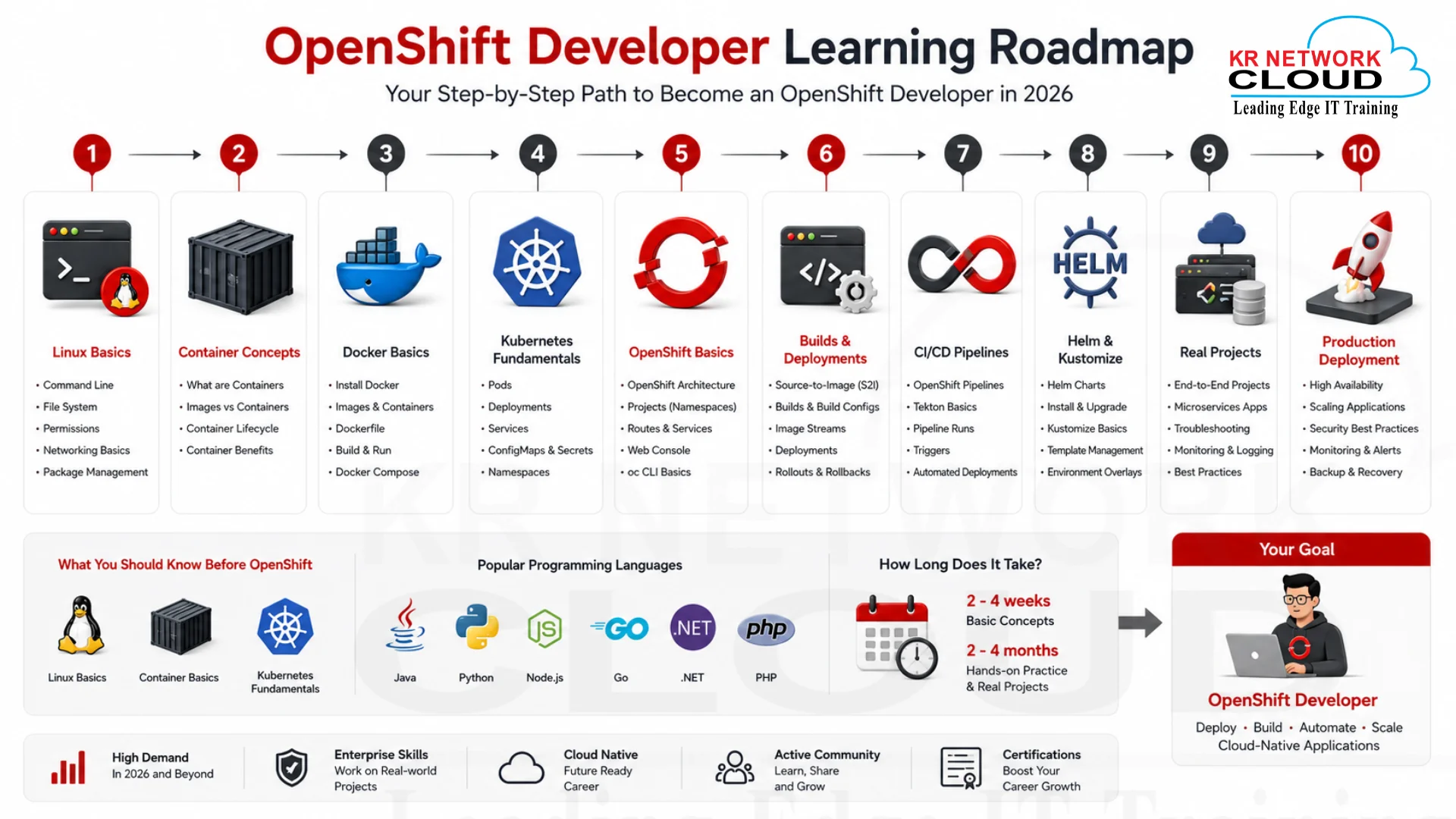
What is the path to be an OpenShift Developer in 2026? / How to Become an OpenShift Developer
As an OpenShift Developer, the focus is on OpenShift application deployment rather than managing the OpenShift cluster. If you want to know How to Become an OpenShift Developer, following a structured OpenShift Developer Roadmap is critical.
An example OpenShift Learning Path and OpenShift Certification Roadmap is:
- Basic Linux
- Containers and Docker
- Kubernetes
- OpenShift and application deployment via OpenShift
- Container images, builds, and deployments
- Helm, Kustomize, OpenShift Pipelines
- OpenShift and application deployment via OpenShift
Building applications is the best way to learn OpenShift in the least amount of time.
What do I need to learn before OpenShift?
There are some technologies you should learn before starting your OpenShift Developer Training. First is Linux as OpenShift use a lot of command line work. Though you don’t need to be an expert on Docker, learning how to use it may help. Kubernetes is very important, as based on Kubernetes, OpenShift incorporates concepts like Pods, Deployments, Services and Namespaces.
The preparation path should entail:
- Linux Basics
- Container Basics
- Kubernetes Basics
- OpenShift
This will greatly ease your progress through any formal OpenShift Certification Course.
Can OpenShift be learned by a beginner?
Yes, learning OpenShift is a possibility for beginners. Enrolling in focused OpenShift Training for Beginners or studying OpenShift for Beginners modules makes it highly accessible. OpenShift, however, is not commonly the first IT technology that people learn. With some basic understanding of Linux and containers, along with the core fundamentals, the learning process is greatly facilitated.
OpenShift can even be learned by non-programmers. Most OpenShift professionals work as administrators, DevOps engineers, and support engineers without the need to write extensive application code. The only requirement is the interest to engage in the learning of Linux, containers, and cloud-native computing.
What is the best programming language for OpenShift?
OpenShift does not require a particular programming language since it is a platform-agnostic solution. The programming languages that are used most frequently on OpenShift are:
- Java
The largest part is hands-on learning. People who are able to deploy and troubleshoot applications develop skills much quicker than those who only learn by watching and reading. This highlights the necessity of OpenShift Online Training that incorporates live labs.
DO288 Training & DO288 Course Details
Is DO288 worth it? Who should take it?
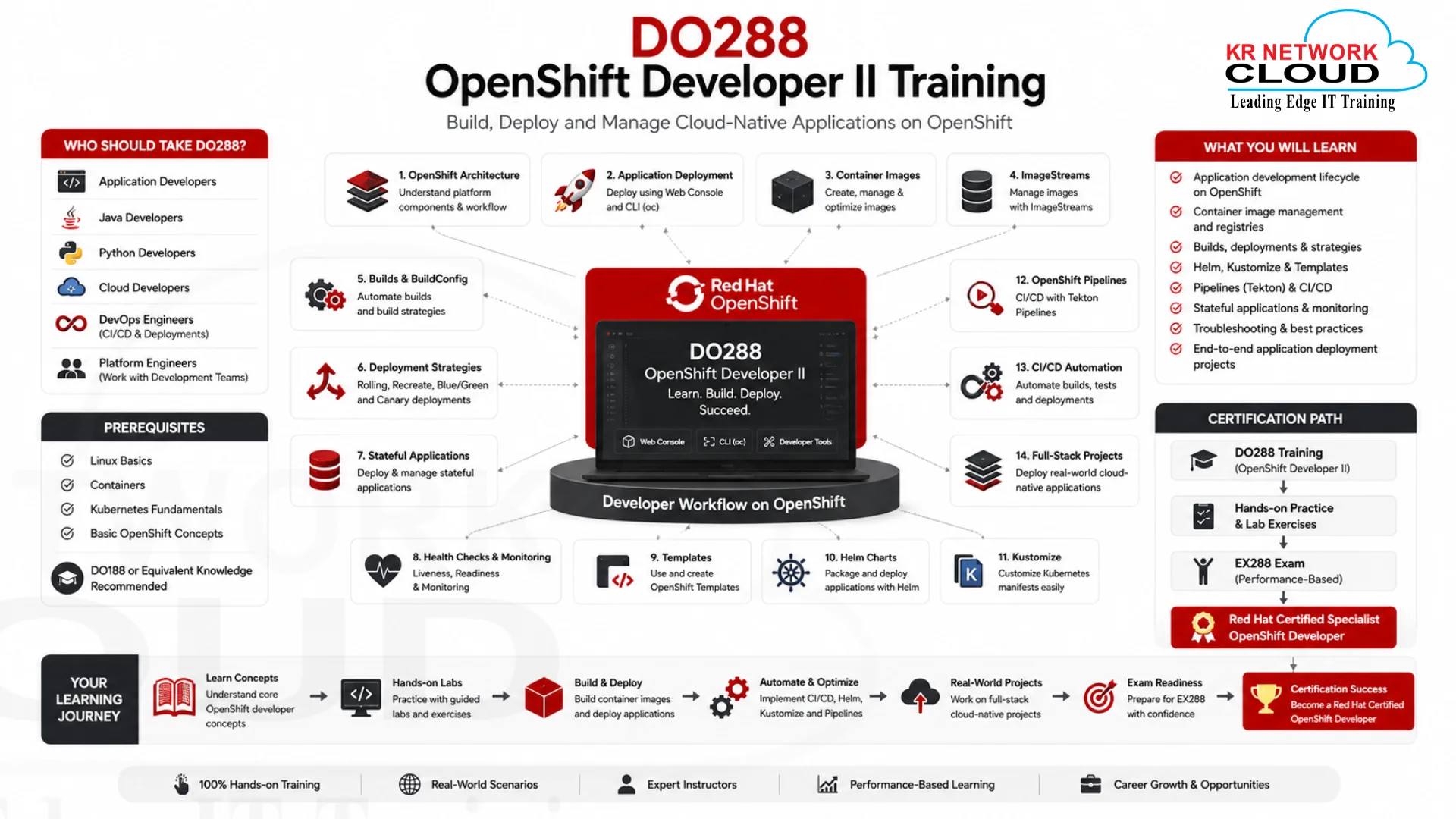
Enrolling in DO288 Training or a formal DO288 Course is highly worth it for people who would rather learn how to develop, deploy, and manage applications on OpenShift, instead of learning how to manage the OpenShift platform. This specialized Red Hat DO288 Training, also known as OpenShift Developer II Training, is a core component of an engineer’s OpenShift Developer Certification path.
This course is best suited for:
- Application Developers
- Java Developers
- Python Developers
- Cloud Developers
- DevOps Engineers with a focus on CI/CD and deployments
- Platform Engineers with a development focus.
If you are more interested in managing users, security, networking, clusters, and OpenShift administration, then DO280 is more appropriate. If you are interested in deploying applications, building and managing container images, and using Helm and Kustomize with OpenShift Pipelines, then completing DO288 Online Training or DO288 Certification Training is the perfect choice for you.
What do you learn in DO288?
The DO288 Course teaches you how to manage deployment of cloud-native applications built on OpenShift (Openshift Certification). To successfully build your skills, comprehensive DO288 Hands-On Training covers the following topics:
- OpenShift architecture and development workflows
- Deployment of applications with the Web Console and CLI
- Creation and management of container images
- Image registries and management of Image Streams
- OpenShift Builds and BuildConfigs
- Various deployment strategies
- Deployment of Stateful applications
- Health checks with application monitoring
- OpenShift Templates
- Helm Charts
- Kustomize
- OpenShift Pipelines (Tekton)
- CICD
- Fully interactive and automated deployment of applications
This OpenShift Developer Training is very hands-on and focuses on development and deployment of applications rather than administration of clusters.
Can I take DO288 without completing DO280?
You can, but it does depend on your experience. With regards to DO288 Training, the curriculum expects students to have a foundational understanding of OpenShift and containers. The prerequisite for the course is DO188 or an equivalent course.
If you have the following skills:
- Some knowledge of Linux
- Knowledge of containers
- Knowledge of Kubernetes
- Some knowledge of OpenShift (Openshift Certification)
You are able to go straight to your DO288 Certification Training. If you have no prior experience with OpenShift (Openshift Certification), the easiest route is to take DO280 to gain OpenShift administration skills, which will help you a lot when transitioning to DO288 Online Training.
Is DO288 enough to clear EX288?
DO288 Training serves as the main course for the EX288 Certification and thoroughly goes through the concepts that the exam checks. However, the course by itself is not enough to clear the exam. The EX288 Exam is a practical, hands-on test. You need thorough DO288 Exam Preparation to perform the tasks without a guided walkthrough.
Some good ways to approach your EX288 Exam Preparation are to:
- Do the course DO288 Training and complete all the exercises multiple times
- Practice doing the deployments by memory
- Build and manage images of containers
- Practice using Helm
- Practice using Kustomize
- Create and troubleshoot Pipelines
- Practice deploying applications
Most of the people who clear the Red Hat EX288 Certification have done a lot of rigorous EX288 Preparation work after completing their course. The exam is practical in nature, and for a lot of people, it is more important to have the practical experience than to have the theories on concepts memorized.
EX288 Certification & EX288 Exam Insights
How difficult is it to clear the EX288 certification?
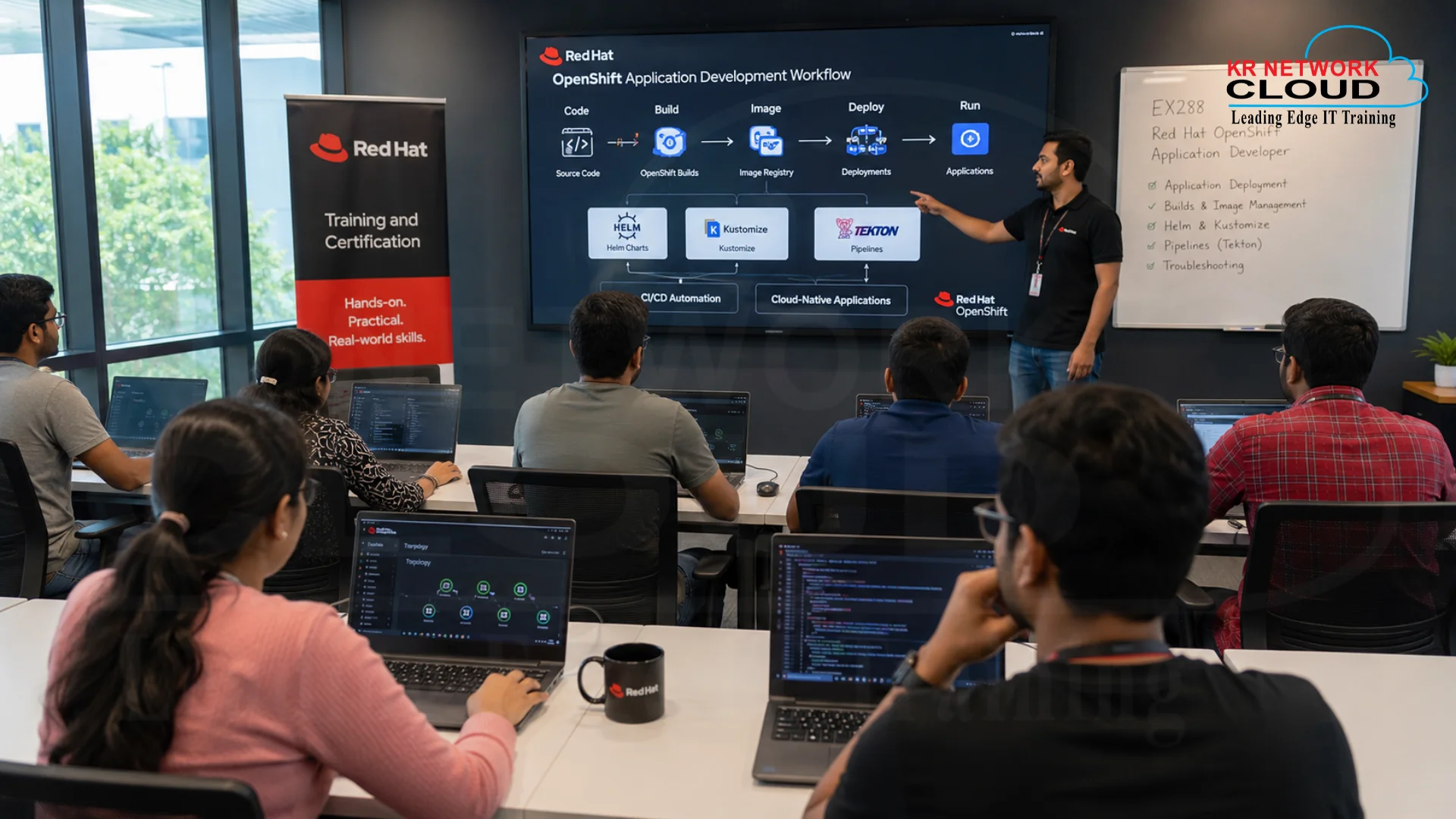
The EX288 Certification is considered to be a certification that is of moderate to high difficulty because of the practical nature of the certification exam. Unlike multiple choice-based certification exams, the EX288 Exam assesses your ability to perform development tasks on OpenShift Certification in real-world scenarios.
Dedicated EX288 Training and EX288 Certification Training examines your proficiency in:
- Application deployment
- Build management
- Container image management
- Helm and Kustomize
- OpenShift Pipelines
- Deployment issues and troubleshooting
The level of difficulty for the Red Hat EX288 Certification as compared to CKAD is completely reliant upon your personal experience. CKAD deals with development of applications on Kubernetes, whereas the EX288 Exam deals with development of applications on OpenShift.
Candidates who have OpenShift experience find the EX288 Certification much easier. Candidates who only have Kubernetes experience will have to spend additional time in EX288 Preparation learning OpenShift integrations, tools, and methodologies. It is manageable to learn new tools; the major barrier to passing the exam is learning to perform tasks correctly under a strict time constraint.
What is the EX288 exam pattern and how is it scored?
The EX288 Exam is a hands-on, practical exam. You will be provided with an instance of OpenShift and a series of tasks to perform. There will not be any multiple choice questions.
Key facts to support your EX288 Exam Preparation:
- Duration: 3 Hours
- Format: Hands-on Practical Exam
- Purpose: Complete multiple practical tasks
- Passing Score: 70% or higher
The number of tasks set may vary as Red Hat prefers to measure practical outcomes as opposed to a set number of questions. The exam is passed by completing the required tasks with the correct configurations in the allotted time.
What will be on the EX288 Exam and how can I study for it?
The exam heavily references the core DO288 Training course. Some examples include:
- Application deployment
- Container images
- OpenShift Builds
- ImageStreams
- Deployment management
- Health checks
- Helm Charts
- Kustomize
- OpenShift Pipelines
- CI/CD workflows
- Application deployment troubleshooting
Some effective study methods using EX288 Practice Labs include:
- Finish all the labs in the DO288 Course.
- Repeat labs, this time without the workbooks.
- Practice troubleshooting when a deployment fails.
- Deploy using Helm and Kustomize, and do it from scratch each time.
- Build and run Pipelines on repeat.
- Implement Kustomize and Pipelines via the Web Console and the CLI.
Some common issues students run into during their EX288 Preparation include:
- Memorizing commands without understanding their usage context.
- Lack of hands-on labs and practice.
- Failing to implement troubleshooting.
- Spending excessive time on a single task in the exam.
- Over reliance on notes.
Is it possible to take the exam without any practical experience?
Yes, if you have done a significant amount of hands-on practice using EX288 Practice Labs. Students who practice labs and build apps will pass the exam before students who focus on theoretical study.
Is it worth taking EX288?
Yes, if you do any work at all with OpenShift or if you want to build a stable OpenShift Developer Career in Cloud-Native Development, the EX288 Certification allows you to demonstrate that you have the skills needed to deploy, manage, and automate applications in an Enterprise OpenShift environment.
These benefits may most apply to:
- OpenShift Developers
- DevOps Engineers
- Platform Engineers
- Cloud Engineers
- Application Modernization Teams
The main benefits stem from the practical skills built during your OpenShift Certification Training, not just the certification itself. OpenShift customers look for candidates with the ability to independently handle application deployment, CI/CD, and container workloads, which are the core skills validated in the EX288 Exam.
Career Opportunities
Is OpenShift a good career choice in India? / OpenShift Career in India
An OpenShift Career in India is an excellent choice, and even more so for cloud, DevOps, platform, and enterprise infrastructure specialists. The big customers that need a safe, scalable, and production-ready Kubernetes platform use OpenShift, and as more customers modernize their applications and consume cloud-native technologies, the need for OpenShift skills will grow.
OpenShift also remains a good choice for long-term career growth, as it encompasses a number of in-demand skills like:
- Kubernetes
- Containers
- DevOps
- CI/CD
- Cloud Platforms
- Platform Engineering
OpenShift is not a siloed skill, and helps grow your expertise across various technologies.
What jobs can you do with OpenShift certification?
Earning an OpenShift Certification can help you secure the following roles:
- OpenShift Developer
- OpenShift Administrator
- OpenShift Engineer
- DevOps Engineer
- Platform Engineer
- Cloud Engineer
- Site Reliability Engineer (SRE)
- Kubernetes Engineer
For fresher candidates, OpenShift is usually not enough to land a job. Employers look for a mix of Linux, containers, Kubernetes, cloud, and OpenShift skills.
Listed below are examples of industries where companies that offer OpenShift systems work:
- IT Services
- Consulting
- Telecom
- Banking and Finance
- Cloud Services
- Product Technology
Many companies that work with Red Hat are searching for professionals who have an understanding of OpenShift deployments and operations.
What is the OpenShift Salary in India? / OpenShift Developer Salary
The OpenShift Developer Salary and general administrator packages are heavily impacted by the level of experience, the city, knowledge of the cloud, and overall technical skills.
Salary structures are generally:
OpenShift Developer
- Junior (Freshers and Up to 2 Years): ₹4 LPA to ₹8 LPA
- Mid-Level: ₹8 LPA to ₹18 LPA
- Senior (≥ 18 LPA): ₹18 LPA+
OpenShift Administrator
- Mid-Level: ₹7 LPA to ₹15 LPA
- Senior (≥ 15 LPA): ₹15 LPA to ₹25 LPA+
OpenShift/Platform Engineer
- Senior (≥ 15 LPA): ₹15 LPA to ₹35 LPA+
Those who have deep knowledge of OpenShift and have skills in Kubernetes and cloud infrastructure (AWS, Azure) alongside expertise in DevOps, automation, and platform engineering are the highest earners.
Is there a cost to practicing OpenShift at home?
No, many students learn OpenShift successfully from home with free resources. OpenShift learning does not require an expensive physical lab. For those who want to install OpenShift on their own, the specs of the system should be:
- Minimum: 16 GB RAM
- Recommended: 32 GB RAM
- CPU: 4+ CPU Cores
- Storage: SSD Storage
With 16 GB RAM, OpenShift can be installed in a way that is only resource intensive. With 32 GB of RAM, it can run more smoothly. Don’t worry if you have some hardware constraints. You can still leverage OpenShift Online Training platforms and tools like:
- Red Hat Developer Sandbox
- OpenShift Local (CRC)
- Remote lab environments
- Training lab environments provided during formal training sessions
Don’t spend too long working on your personal installation lab; focus on deploying applications instead. There tend to be a number of installation professionals who lack knowledge on deployment, building, creating pipelines, or troubleshooting. Being an OpenShift installer isn’t the end goal, becoming a certified OpenShift professional is.
The most beneficial labs to work on are:
- Active application deployment
- Working with and creating container images
- Working and creating Helm Charts
- Working with and configuring Kustomize
- Creating OpenShift Pipelines
- Troubleshooting deployment failures
It is these skills and practical knowledge that most employers tend to value.
Final Recommendations for Your OpenShift Career Path
If your desired career is within the cloud, DevOps, or platform and enterprise application development, then OpenShift is definitely worth learning. Always remember: do not learn OpenShift in place of learning Kubernetes. The only way you successfully learn OpenShift is if you know Kubernetes. Kubernetes is the foundation; OpenShift is how enterprises deploy Kubernetes in production.
When companies are hunting for professionals, the ideal candidates are almost always those that have an integrated knowledge of:
- Linux
- Containers
- Kubernetes
- CI/CD
- Cloud
- Automation
OpenShift combines all of these elements.
For Developers, the suggested path is:
Linux→Containers→Kubernetes→OpenShift→Helm→Kustomize→Pipelines→CI/CD
For DevOps Engineers, the recommended path is:
Linux→Docker→Kubernetes→OpenShift→Git→Jenkins/Tekton→Ansible→Clouds→Platform Engineering
Beyond OpenShift, completing an OpenShift Certification Course can prepare you for key certifications including:
- EX288 (OpenShift Developer)
- EX280 (OpenShift Administration)
- CKAD (Certified Kubernetes Application Developer)
- CKA (Certified Kubernetes Administrator)
- AWS Certifications
- Azure Certifications
For more insights on these certification pathways, you can refer to the comprehensive guidelines found in Article Topics – Google Docs.pdf. The engineers who excel in their careers the most are those who are able to clearly and confidently deploy, automate, and troubleshoot applications in production, not just those who have memorized theories. If you focus on understanding OpenShift deeply, your skills will continue to grow in value as the industry shifts and changes.
KR Network Cloud’s Official Red Hat OpenShift Course Pages
- Red Hat OpenShift Development I: Introduction to Containers with Podman (DO188)
- Red Hat OpenShift Administration II: Configuring a Production Cluster (DO280/EX280)
- Red Hat OpenShift Developer II (DO288/EX288)
- Red Hat OpenShift Virtualization (DO316/EX316)
- Red Hat OpenShift Administration III (DO380/EX380)
- Kubernetes Application Developer (CKAD)
- Red Hat OpenShift AI (AI267)