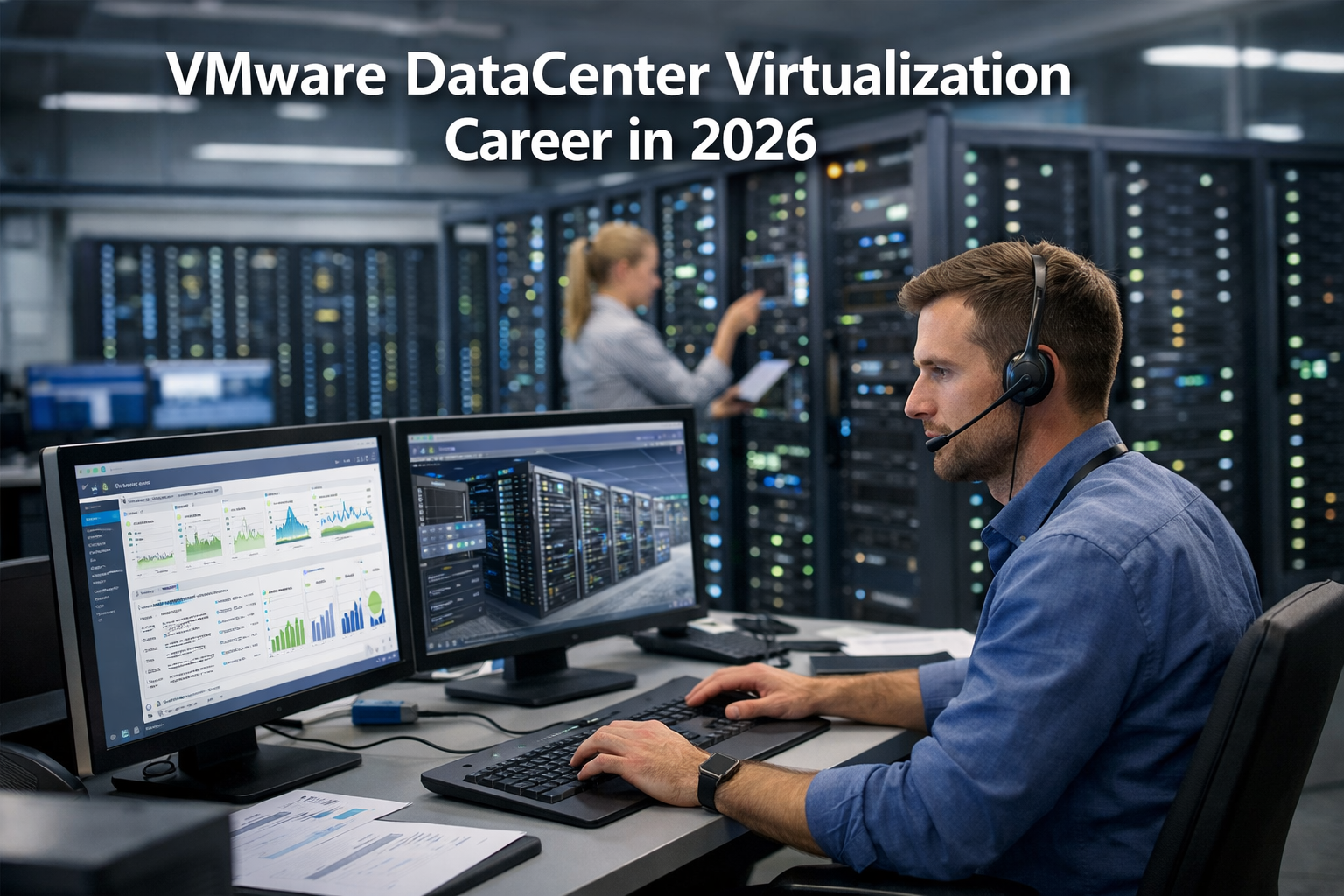
VMware DataCenter Virtualization Career in 2026
- KR NETWORK CLOUD
- March 20, 2026
Why DataCenter Virtualization Still Matters in 2026
From a learner’s point of view, DataCenter Virtualization is still a strong domain in 2026 because many companies continue to run their applications on private infrastructure. Even though public cloud platforms are growing, large organizations still keep their internal servers for security, compliance, and cost control.
Banks, telecom companies, government departments, and big IT service providers maintain their own data centers, and these data centers mostly run on virtualization platforms. Because of this, learning virtualization is still useful for someone who wants to work in infrastructure, cloud, or system administration roles.
Another reason virtualization matters is that cloud platforms themselves are built on virtualization concepts. A learner who understands virtualization finds it easier to understand cloud, containers, and hybrid infrastructure.
If you want to start a career in IT, you might hear a lot about the cloud. But behind the cloud, there is a technology called virtualization. In 2026, VMware is still the top name in this field. This guide explains why it is a smart move for your career.
Why DataCenter Virtualization Still Matters in 2026
Most big companies do not put all their data on the internet. They keep their own servers in a private building called a data center. Virtualization is the tool that makes these servers work better.
In the past, one physical server could only run one system. With virtualization, one physical server can run fifty systems at the same time. This saves money, space, and power. Even in 2026, companies need this to keep their costs low.
What is VMware DataCenter Virtualization
VMware DataCenter Virtualization means running multiple virtual machines on a single physical server using VMware software. Instead of installing one operating system per server, virtualization allows many systems to run on the same hardware.
The main VMware technologies used in data centers include:
- VMware ESXi – Hypervisor used to create virtual machines
- VMware vCenter Server – Used to manage multiple ESXi hosts
- VMware vSphere – Complete virtualization platform
- VMware vSAN – Storage virtualization
- VMware NSX – Network virtualization
From a learner’s view, these tools form the base of many enterprise data centers, which makes VMware a useful skill for infrastructure roles.
Why VMware is Still Used in Enterprises in 2026
Many learners think public cloud has replaced virtualization, but in actual enterprise environments VMware is still widely used.
Reasons why companies continue using VMware:
- Existing data centers already built on VMware
- High control over internal infrastructure
- Required for private cloud environments
- Used in hybrid cloud with AWS, Azure, and Google Cloud
- Trusted platform for critical workloads
Large companies cannot move everything to public cloud due to security rules, internal policies, and long-term investments in hardware. Because of this, VMware administrators are still needed.
Why VMware as a Technology Introduced in IT Industries
Virtualization became popular when companies wanted to reduce hardware cost and manage servers more easily. Before virtualization, one application required one server, which increased power usage, space, and maintenance.
VMware introduced the hypervisor concept that allowed multiple systems to run on one machine. This changed how data centers were designed.
From a learner’s point of view, VMware is one of the technologies that shaped modern IT infrastructure. Many current tools in cloud and DevOps are based on the same ideas that virtualization introduced earlier.
Is VMware Still Valuable in Current IT Industries
Yes, VMware is still valuable, especially for learners who want to work in:
- System Administration
- Data Center Operations
- Private Cloud
- Hybrid Cloud
- IT Support / Infrastructure
- Cloud Migration Projects
Many job roles still require knowledge of vSphere, ESXi, and vCenter.
Even companies using AWS or Azure often keep part of their systems on VMware.
For learners, this means virtualization knowledge can open multiple paths instead of limiting career options.
VMware Relevance Against Public Cloud
For Employees
- More job roles in infrastructure and support
- Useful for hybrid cloud environments
- Helps in cloud migration projects
- Good base for learning AWS, Azure, Kubernetes
Employees with VMware knowledge often work in data center, NOC, cloud, or system teams.
For Companies
- Full control over internal servers
- Better for sensitive data
- Long-term hardware investment usage
- Required for private cloud setups
- Works with hybrid cloud models
Many organizations use both VMware and public cloud together.
For Individual Learners
- Good starting point for infrastructure career
- Helps understand server, storage, and network
- Useful before learning cloud or DevOps
- Certification adds credibility in interviews
- Many support and admin roles need virtualization knowledge
For beginners, VMware is easier to understand compared to cloud architecture.
KR Network Cloud – Training Program
KR Network Cloud provides training focused on DataCenter Virtualization and VMware technologies for learners who want to enter infrastructure or cloud domains.
The training usually covers:
- VMware ESXi installation
- vCenter management
- Virtual machine creation
- Networking in VMware
- Storage configuration
- Basic troubleshooting
- Introduction to private cloud
For learners preparing for certification or job roles in system administration, this type of training helps in building clear understanding of how enterprise data centers work.
About Certification
VMware certifications are recognized in many companies that use virtualization.
Popular certification paths include:
- VMware Certified Technical Associate (VCTA)
- VMware Certified Professional (VCP)
- VMware Certified Advanced Professional (VCAP)
Among these, VCP is commonly required for administrator roles.
Certification preparation usually includes:
- Understanding vSphere architecture
- Working with ESXi and vCenter
- Managing virtual machines
- Networking and storage basics
- Monitoring and troubleshooting
From a learner’s point of view, certification shows that the candidate understands enterprise virtualization tools.
Is it Relevant to Go for VMware Certification in 2026
From a learner’s perspective, VMware certification is still relevant in 2026, especially for those who want to build a career in infrastructure, private cloud, or hybrid cloud environments.
Reasons why it still makes sense:
- Many companies still run VMware data centers
- Hybrid cloud needs virtualization knowledge
- Useful base before learning cloud platforms
- Required in system admin and support roles
- Certification helps in interviews for infrastructure jobs
Public cloud is growing, but virtualization has not disappeared.
For learners who want to start from core infrastructure and then move to cloud or DevOps, VMware remains a good choice in 2026.