What an OpenShift Administrator Actually Does on the real job
Daily Responsibilities Inside IT Companies
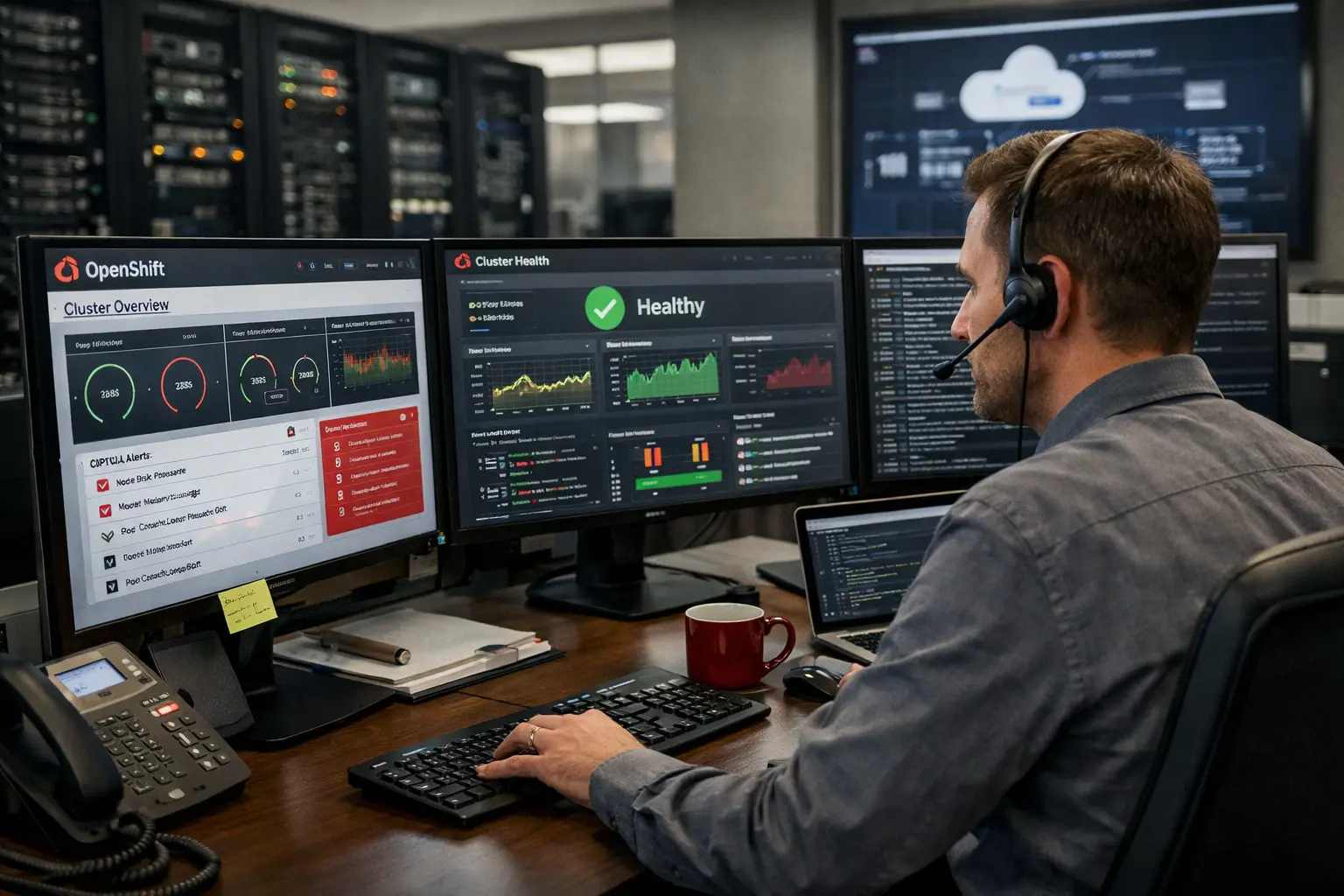
An OpenShift administrator’s day does not begin with large architectural decisions. Instead, it usually begins with checking whether the platform is behaving the same way it did yesterday. In most cases, cluster health, node status, operator conditions, and alerts collectively form the background noise of the role. As a result, this work consistently sits at the intersection of OpenShift administration and ongoing operational vigilance.
At the same time, routine tasks tend to repeat, though rarely in a predictable order. For example, patching nodes, monitoring resource utilization, validating backups, and reviewing certificate expiry timelines are all common activities. Individually, none of these appear complex. However, in practice, they frequently overlap with live deployments, active users, and internal deadlines. Consequently, this is where formal OpenShift training often begins to diverge from operational reality.
An administrator trained through Red Hat OpenShift training typically understands how to execute commands correctly. However, on the job, the more critical challenge is determining when to execute them. In reality, a cluster rarely exists in a neutral state. Instead, something is almost always running, waiting, or partially failing, which continuously influences operational decision-making.
Typical daily responsibilities include:
- Monitoring cluster and node health through the OpenShift console and CLI
- Managing upgrades and patches with awareness of application dependencies
- Handling storage, networking, and ingress-related issues as they arise
- Supporting development teams with platform-level problems
- Coordinating with security teams on compliance and access controls
These responsibilities are not sequential. They interrupt one another.
Learning Labs Versus Production Work
Most OpenShift courses are structured around clean environments. Labs start empty, commands succeed, and resources behave as expected. This is necessary for learning, but it creates a misleading sense of control.
Production environments are rarely empty. Namespaces already exist. Operators have histories. Configuration drift is common. An administrator working after completing an OpenShift certification quickly learns that production work is less about knowing what to do and more about understanding what not to touch at a given moment.
Key differences between labs and real environments often include:
- Multiple teams deploying simultaneously
- Partial failures where systems remain technically “up”
- Legacy configurations that no one fully owns anymore
- Business constraints overriding technical preferences
A Red Hat Certified OpenShift Administrator course prepares candidates to understand components. It does not simulate organizational pressure, competing priorities, or incomplete documentation. That gap becomes apparent early.
Interaction With Developers
Developers interact with OpenShift daily, even if they do not consciously think about the platform itself. However, when something breaks, the administrator becomes the first escalation point. In most cases, the conversation usually starts with application symptoms and then slowly moves toward platform behavior.
In practice, some developers understand containers deeply. Others, by contrast, treat OpenShift as infrastructure that should resemble traditional servers. As a result, the administrator adjusts language accordingly, switching between platform concepts and more practical explanations.
Common interaction points include:
- Pod restarts, crash loops, and failed deployments
- Resource limits and requests causing throttling
- Image pull failures or registry access issues
- Networking and route misconfigurations
This interaction is not purely technical. It involves expectation management. The administrator often explains why certain behaviors are inherent to the platform, not errors. OpenShift administration in this context becomes a translation role.
Incident Handling Expectations
Incidents rarely align with textbook definitions. Instead, alerts are often vague, while symptoms evolve over time. Consequently, the OpenShift administrator’s first task becomes determining whether the issue is platform-wide or isolated. To support this assessment, metrics, events, and logs are consulted, frequently under significant time pressure.
During incidents, administrators are therefore expected to:
First, identify whether OpenShift components are contributing to the issue
Next, restore service without introducing additional instability
Simultaneously, communicate clearly with multiple teams at the same time
However, despite the expectation of speed, restraint remains critical. Acting too quickly can, in fact, amplify existing problems. Training environments, by contrast, rarely emphasize this balance. In real operations, incident handling reinforces this lesson repeatedly.
Ultimately, an OpenShift course explains how components work. By comparison, incident response demonstrates how those same components fail.
Responsibilities Beyond the Console
Not all OpenShift administration happens inside the CLI. Documentation, informal runbooks, and internal notes play a quiet but critical role. These are rarely polished documents. They evolve from repeated incidents and small discoveries.
Administrators also spend time coordinating:
- Upgrade schedules across teams
- Access requests and permission reviews
- Cross-cluster consistency in multi-cluster setups
As environments scale, the role shifts slightly. Automation increases, but so does the need for governance. A certified administrator often becomes a reference point for platform decisions, even when those decisions are not strictly technical.
Career Growth After OpenShift Certification
Completing OpenShift certification or a Red Hat Certified OpenShift Administrator course does not define a single career path. It signals platform competency. What follows depends on context and interest.
Common directions include:
- Platform engineering and internal tooling
- Cloud infrastructure and hybrid deployments
- Security-focused roles aligned with container platforms
- Reliability or operations leadership roles
Some professionals remain deeply focused on OpenShift administration. Others, however, treat it as a foundational layer. In this context, Red Hat OpenShift training provides credibility, but experience ultimately determines progression.
After certification, there is often a period of ambiguity. During this phase, the title may remain the same while responsibilities continue to expand. Over time, the administrator gradually moves from execution toward decision-making, sometimes without any formal change in role.
The Ongoing Nature of the Role
An OpenShift environment never feels finished. Platform versions change. APIs deprecate. Organizational expectations evolve. Administrators track updates, but not every change becomes visible until it causes friction.
The distinction between learning and working persists. Labs remain references. Production remains unpredictable. An OpenShift course may explain how something should behave. Daily work reveals how it actually behaves.
The role sits between stability and change, rarely resolving into one or the other.