Declarative Resource Management in OpenShift: How Admins Enforce Configuration Consistency at Scale
- KR NETWORK CLOUD
- January 21, 2026
Enterprise OpenShift environments rarely fail in obvious ways. More often, they drift. Configuration changes accumulate, intent becomes unclear, and the gap between what teams believe is running and what is actually running grows wider over time. Declarative resource management exists to narrow that gap. For working professionals responsible for platform stability, security, and auditability, understanding how declarative management works in OpenShift is not optional. It is foundational to reliable operations at scale.
This article examines declarative resource management in Red Hat OpenShift, focusing on how administrators enforce consistency, where the model strains under real operational pressure, and how Git-based workflows change day-to-day OpenShift administration.
What Declarative Resource Management Means in OpenShift
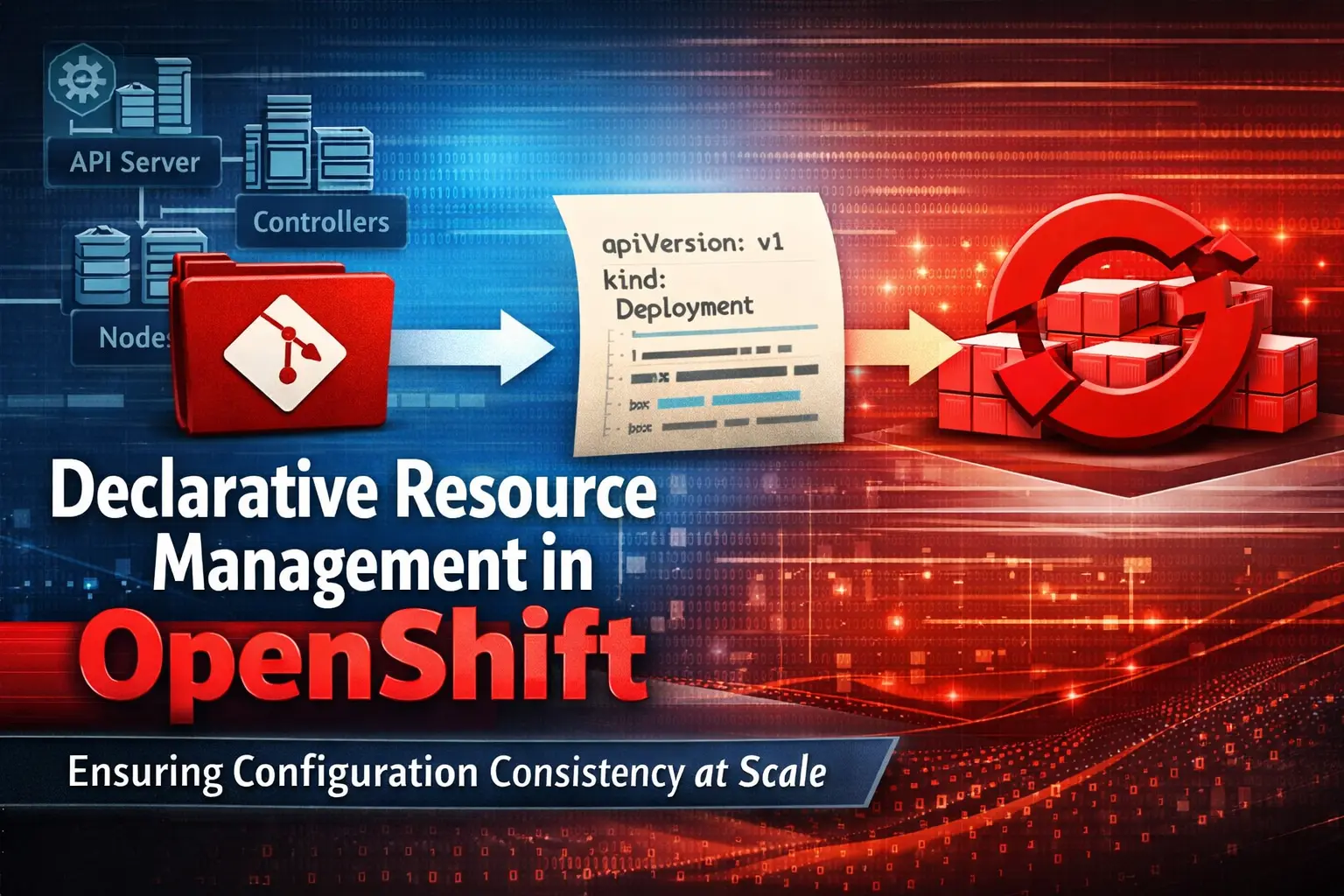
Declarative resource management is not just about using YAML files. It is about shifting operational authority from ad hoc actions to an explicit description of desired state. In OpenShift, this description is expressed through Kubernetes-style manifests that define what should exist, not how to create it.
When a manifest is applied, the OpenShift API server stores intent. Controllers then work to reconcile actual cluster state toward that intent. This separation between intent and execution is the core of the model. It also introduces friction for teams accustomed to direct, imperative control.
Declarative management becomes especially relevant as OpenShift clusters grow. More teams, more namespaces, more Operators, and more security controls amplify the cost of inconsistency. At that scale, undocumented manual changes stop being tactical shortcuts and start becoming systemic risk.
Imperative vs Declarative Management Failure Scenarios in Enterprises
Imperative management tends to succeed until it quietly does not. A command is run using oc, a setting is changed through the web console, or a deployment is edited directly during an outage. The cluster reflects the change immediately. There is no visible failure. Over time, these actions accumulate.
The problem is not that imperative changes are always wrong. The problem is that they externalize memory into the cluster itself. The system remembers the result of the action, but not the reason for it. Weeks later, a node restart or upgrade surfaces a latent dependency. Teams then debate what the configuration should be, because no authoritative declaration exists.
Declarative management fails differently. It can be rigid during incidents and slow to adapt under pressure. But its failures are visible. Drift can be detected. Differences between declared and actual state can be reviewed. In enterprise OpenShift environments, the harder failures to recover from are often the silent ones introduced by unmanaged imperative actions.
Enroll for the Openshift Administration training
Structure of OpenShift-Compatible Resource Manifests
OpenShift-compatible resource manifests follow the familiar Kubernetes structure: apiVersion, kind, metadata, and spec. This simplicity is deceptive. The structure does not enforce correctness of intent, only syntactic validity.
Metadata is frequently underappreciated. Labels and annotations may appear optional, but in OpenShift they influence routing, policy enforcement, quota application, and Operator behavior. A manifest can apply cleanly while being structurally incompatible with platform assumptions around governance and isolation.
The spec section carries deeper risk. Defaults assumed from upstream Kubernetes do not always hold in OpenShift. SecurityContext fields may conflict with Security Context Constraints. Image references may resolve differently depending on internal registries and image policies. Two clusters running the same OpenShift version can still interpret the same manifest differently based on configuration outside the YAML.
There are also fields that administrators never write but must understand. Generated annotations, admission-injected metadata, and the status field all affect runtime behavior. They should not live in source control, yet ignoring their influence entirely leads to misinterpretation when debugging behavior that does not match declared intent.
Drift Detection and Reconciliation Behavior in OpenShift
Drift rarely announces itself. Applications continue to serve traffic. Pods restart as expected. Monitoring remains quiet. Somewhere beneath the surface, however, the live state has diverged from what was last declared.
In OpenShift, reconciliation is often described as constant, but in practice it is scoped. Controllers reconcile the resources they own. Fields mutated by admission controllers, Operators, or manual intervention may never be reverted unless a reconciliation loop explicitly covers them. The manifest remains unchanged in Git, while the cluster evolves independently.
Human behavior introduces another layer. Temporary changes applied during incidents may persist indefinitely. Audit logs record them, but logs are not operational memory. When reconciliation tools later reapply manifests, the rollback of these forgotten changes can appear as unexplained breakage.
GitOps tooling improves visibility, but it does not eliminate ambiguity. Some divergence is intentional. Some is tolerated. Some is simply missed. Working professionals must learn to distinguish between acceptable variance and configuration decay.
Git-Based Configuration Governance Model
A Git-based governance model moves decision-making upstream. Configuration changes are proposed, reviewed, and merged before they reach the cluster. The cluster becomes an execution target rather than the primary place where decisions are made.
Version control’s real contribution is traceability. Every change has context. Diffs show what moved and when. That does not guarantee understanding. YAML reviews often focus on avoiding breakage rather than evaluating long-term impact. Subtle shifts can pass unnoticed because the syntax looks familiar.
Operational friction emerges quickly. Emergency fixes feel slower when routed through pull requests. Reverts feel heavier than undoing a command. Teams sometimes bypass the model under pressure, promising to reconcile later. When the declarative system eventually enforces the repository state, it can feel punitive rather than corrective.
Governance also introduces organizational complexity. Branch protections, approvals, and pipeline gates reflect trust boundaries. Those boundaries rarely align perfectly with real on-call responsibilities. At scale, Git can govern configuration, document disagreement, or do both at once.
Real Operational Risks of Unmanaged YAML Sprawl
YAML sprawl grows quietly. Files are copied, slightly modified, and renamed to avoid unintended side effects. The cluster accepts them all. Nothing fails immediately.
Over time, it becomes unclear which manifest is authoritative. Similar resources differ in small but meaningful ways. Platform-injected behavior compounds the confusion. A manifest that behaves one way in one namespace behaves differently in another, and the YAML offers no explanation.
There is also review fatigue. Large diffs become normal. Unrelated changes travel together. The cost of understanding configuration increases, while the perceived cost of adding more YAML decreases.
During incidents, sprawl becomes a liability. Teams search repositories instead of reasoning about the system. Manifests are applied in hope rather than confidence. Cleanup rarely happens because no clear baseline exists. The result is a growing surface area of risk that feels manageable only until it is not.
Summary: Imperative vs Declarative Management in OpenShift
| Aspect | Imperative Management | Declarative Management |
| Source of truth | Live cluster state | Version-controlled manifests |
| Change visibility | Low | High |
| Drift detection | Implicit, manual | Explicit, tool-assisted |
| Incident response | Fast, fragile | Slower, recoverable |
| Long-term scalability | Limited | Designed for scale |
Practical Guidance for Working Professionals
- Treat manifests as contracts, not deployment scripts.
- Assume future administrators will not know the context behind today’s changes.
- Expect some friction when moving fully declarative; plan for it operationally.
- Invest time in repository structure and ownership clarity early.
- Accept that not all drift is bad, but unmanaged drift is always expensive.
How Declarative Management Enforces Consistency at Scale
Consistency in OpenShift does not come from perfect discipline. It comes from making deviation visible and reversible. Declarative resource management provides a reference point. Git-based workflows provide memory. Reconciliation mechanisms provide enforcement, even if imperfect.
For working professionals managing OpenShift clusters, declarative management is less about ideology and more about reducing uncertainty. It allows teams to reason about systems they did not personally build. It supports audits, upgrades, and handovers. It does not eliminate operational judgment, but it constrains the blast radius of undocumented decisions.
If you are responsible for OpenShift platforms in production, declarative resource management is not an abstract concept. It is a daily operational discipline. Formal red hat openshift training or an advanced openshift course focused on openshift administration helps bridge the gap between theory and practice. For professionals aiming to validate their skills, pursuing openshift certification or openshift red hat certification reinforces both technical competence and governance awareness needed to operate OpenShift reliably at scale.
Join the Official OpenShift Training at KR Network Cloud