Red Hat Ansible (RHCE) Career in 2026!

- KR NETWORK CLOUD
- February 24, 2026
Introduction
Today, the IT industry is moving fast toward automation. Earlier, system administrators managed servers manually. However, now companies prefer automation because it saves time, reduces errors, and improves performance.
Because of this change, RHCE (Red Hat Certified Engineer – EX294) has become one of the most valuable certifications in Linux and automation.
If you are planning to start or grow your IT career in 2026, RHCE with Ansible can be a strong choice.
What is Ansible (RHCE)?

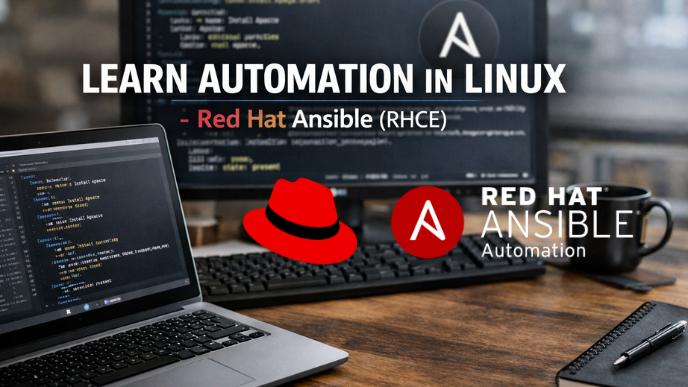
RHCE EX294 is a certification from Red Hat. It focuses on automation using Red Hat Ansible Automation Platform.
In simple words, Ansible is a tool that helps you automate:
- Server configuration
- Software installation
- User management
- Security updates
- Application deployment
Instead of doing tasks manually on each server, you write automation playbooks. As a result, the same task runs on hundreds of servers in minutes.
Therefore, RHCE proves that you can manage and automate Linux infrastructure professionally.
How Red Hat Ansible Helps in IT Industry
Automation is now required in almost every IT company.
For example:
- Companies manage large data centers
- Cloud environments run thousands of servers
- DevOps teams need fast deployments
Because of this, companies prefer engineers who can automate repetitive tasks.
In addition:
- Automation reduces human mistakes
- It improves system consistency
- It saves operational cost
So, RHCE makes you more valuable compared to a traditional Linux administrator.
Demand of Ansible in 2026
The demand for automation engineers is increasing every year.
Industries using Red Hat and Ansible include:
- Banking
- Telecom
- Healthcare
- Government
- Cloud service providers
Moreover, automation is now part of DevOps culture.
Common job roles after learning Ansible and clearing RHCE (EX294) certification:
- Linux Automation Engineer
- DevOps Engineer
- Infrastructure Engineer
- Cloud Operations Engineer
- Site Reliability Engineer
Because companies want faster deployment and stable systems, automation skills remain highly demanded in 2026.
How to Learn Ansible (Step-by-Step Approach)

If you want to build a strong career with Ansible (RHCE), follow this path:
Step 1: Build Linux Fundamentals
You must be comfortable with:
- Linux command line
- File permissions
- User and group management
- Services and storage
- Basic networking
Step 2: Clear RHCSA First
Before RHCE training and certification, you must complete the Red Hat Certified System Administrator (RHCSA).
RHCSA builds your Linux foundation. Without it, automation concepts may feel confusing.
Step 3: Start Ansible Learning
Then focus on:
- Writing playbooks
- Managing inventories
- Using variables
- Creating roles
- Troubleshooting errors
Step 4: Practice Labs Regularly
Since EX294 is a performance-based exam, practice is very important. Therefore, hands-on labs are the key to success.
Certifications Before and After RHCE
Before RHCE:
- RHCSA (Mandatory)
After RHCE:
To grow further, you can move to:
- Red Hat OpenShift (Container & Kubernetes)
- Cloud certifications (AWS, Azure, GCP)
- DevOps tools (Docker, Kubernetes, CI/CD)
As a result, RHCE becomes a bridge between Linux Administration and DevOps/Cloud roles.
Best Practices After Getting a Job
Getting certified is only the beginning. After getting a job:
- Continue improving automation scripts
- Learn Infrastructure as Code concepts
- Work on real-world deployment pipelines
- Understand cloud integration
- Improve troubleshooting skills
Most importantly, never stop learning. Technology keeps evolving.
Career Profiles You Can Grow Into
With experience, you can move into:
- Senior DevOps Engineer
- Automation Architect
- Cloud Architect
- Platform Engineer
- Site Reliability Engineer (SRE)
Therefore, RHCE opens long-term growth opportunities, not just entry-level roles.
Is RHCE Aligned with Future Technologies?
Yes, absolutely. Automation connects directly with:
- Cloud computing
- DevOps
- Containerization
- CI/CD pipelines
- Infrastructure as Code
Because modern IT depends on automation, RHCE skills remain relevant for future technologies as well.
Why Choose KR Network Cloud – Red Hat Authorized Training Partner
KR Network Cloud is a Red Hat Authorized Training Partner in India.
Training benefits include:
- Structured lab-based sessions
- Real-time troubleshooting practice
- Exam-oriented tasks
- Industry-experienced trainers
Therefore, students do not just prepare for certification, they prepare for real job roles.
If you are serious about building a career in Linux automation, practical learning makes a big difference.
FAQs About RHCE Career
1. Is Ansible good for freshers?
Yes, but first complete RHCSA and build strong Linux basics.
2. Is Ansible difficult?
It is practical and performance-based. However, with proper lab practice, it is manageable.
3. Does Red Hat Ansible (RHCE) guarantee a job?
No certification guarantees a job. However, strong skills and hands-on practice improve job opportunities.
4. What salary can I expect after clearing RHCE certification?
Salary depends on skills, location, and experience. However, automation engineers generally earn more than traditional Linux admins.
5. Is Ansible automation useful for DevOps roles?
Yes. Since DevOps focuses on automation, RHCE aligns very well with DevOps jobs.
6. What should I learn after Red Hat Ansible (RHCE)?
You can learn OpenShift, Kubernetes, cloud platforms, and CI/CD tools.
7. Is Ansible Automation relevant in 2026 and beyond?
Yes. Because automation is growing rapidly, RHCE remains relevant for future IT careers.
8. How long does it take to prepare for RHCE certification?
Usually, 2-4 months with consistent practice, depending on your Linux background.
Final Conclusion
If your goal is to build a stable and future-ready IT career, RHCE (Red Hat Ansible) is a strong choice in 2026.
It not only improves your Linux automation skills but also prepares you for DevOps and cloud-based roles.
However, remember this: certification opens the door, but practical knowledge builds your career.
If you focus on strong fundamentals, hands-on labs, and continuous learning, RHCE can become a powerful career path for you.