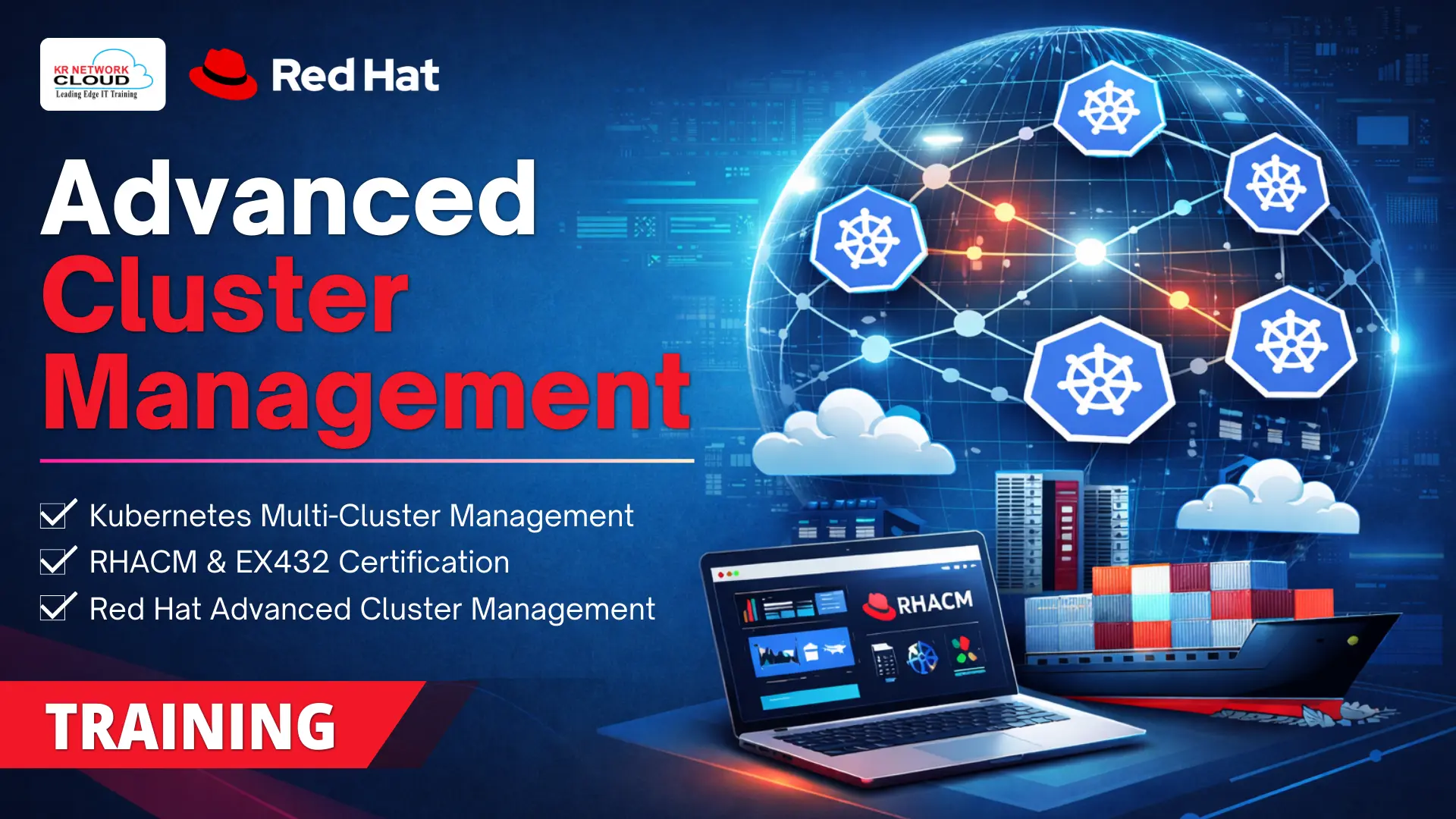
Advanced Cluster Management: A Practical Career Guide for Enterprise Kubernetes
- KR NETWORK CLOUD
- January 16, 2026
Kubernetes adoption has moved far beyond single-cluster environments. What began as a container orchestration platform for isolated workloads has gradually evolved into the backbone of enterprise infrastructure. Consequently, organizations today operate dozens, and sometimes hundreds, of Kubernetes and OpenShift clusters across data centers, public clouds, and hybrid environments. This shift has made Advanced Cluster Management a critical operational capability rather than an optional enhancement.
As Kubernetes environments scale, operational complexity increases exponentially. Managing clusters individually often results in inconsistent configurations, security gaps, limited visibility, and elevated operational risk. Accordingly, enterprises now require a centralized approach to Kubernetes multi cluster management to maintain stability, compliance, and control.
Kubernetes Multi Cluster Management: From Simplicity to Enterprise Complexity
Early Kubernetes deployments typically focused on running workloads inside a single cluster, with limited concern for cross-environment coordination. Over time, however, production demands forced organizations to distribute workloads across regions for high availability, across clouds for resilience, and across environments to satisfy regulatory and latency requirements.
This evolution introduced several operational challenges:
- Lack of centralized control across clusters
- Difficulty enforcing security and compliance consistently
- Fragmented observability and monitoring
- Manual and error-prone cluster lifecycle operations
Ordinarily, teams struggled to address these issues using native Kubernetes capabilities alone. Native Kubernetes does not provide centralized governance across clusters; nevertheless, enterprises must still maintain control at scale. Consequently, organizations adopted Advanced Cluster Management for Kubernetes to address these operational gaps in real-world environments.
What Is Red Hat Advanced Cluster Management for Kubernetes (RHACM)?
Red Hat Advanced Cluster Management for Kubernetes (RHACM) is an enterprise platform that enables centralized management of Kubernetes and OpenShift clusters from a single control plane. It provides consistent lifecycle management, governance enforcement, and observability across multiple clusters and environments.
RHACM addresses three fundamental enterprise requirements:
- Cluster lifecycle management, allowing teams to create, import, upgrade, and manage clusters consistently
- Governance and compliance, ensuring that security and configuration standards apply uniformly across all managed clusters
- Visibility and observability, giving platform teams a centralized view of cluster health, performance, and compliance status
Enterprises rely on Advanced Cluster Management for Kubernetes because it aligns with operational realities rather than theoretical Kubernetes usage.
For your Reference If you want to understand waht is Cluster, watch this video What is Clustering?
Why Advanced Cluster Management Is Not an Entry-Level Skill
RHACM does not target beginners who are still learning basic Kubernetes concepts. Instead, it operates at the platform and architectural level, assuming prior experience with Kubernetes, OpenShift, and production workloads. Consequently, engineers must already understand cluster behavior, access control, and operational failure scenarios.
This capability fits directly into platform engineering, where teams build and operate internal platforms that application teams depend on. Conversely, entry-level Kubernetes usage focuses on deploying workloads, not governing platforms. Accordingly, organizations expect engineers working with Red Hat OpenShift to understand RHACM as part of their responsibility for production stability, security, and compliance.
Who Should Learn RHACM and What Are the Prerequisites?
This training targets professionals who already operate Kubernetes or OpenShift in real environments. Ideal candidates include:
- OpenShift Administrators
- Kubernetes Engineers
- DevOps Engineers
- Site Reliability Engineers
- Platform Engineers
To self-qualify honestly, participants should possess working knowledge of Linux and networking fundamentals, hands-on experience with Kubernetes workloads and YAML, familiarity with Red Hat OpenShift concepts, and a basic understanding of Git and declarative configuration. Without this foundation, RHACM concepts will feel abstract, notwithstanding the quality of the training, because the platform addresses enterprise-scale challenges rather than introductory workflows.
Real Outcomes of Red Hat Advanced Cluster Management Training
A structured RHACM training program emphasizes enterprise-grade outcomes rather than theoretical understanding. Learners develop the ability to:
- Perform centralized Kubernetes multi cluster management
- Manage full cluster lifecycles across environments
- Implement governance and compliance using policy-based controls
Moreover, participants gain experience with:
- Multicluster observability
- GitOps workflows for application lifecycle management
- Virtualization on Kubernetes using OpenShift Virtualization
These outcomes reflect how modern enterprises operate Kubernetes platforms at scale, not how labs simulate them.
EX432 Certification: What It Validates in Real Environments
The EX432 Certification validates hands-on ability to manage multicluster environments using RHACM. The Red Hat EX432 course and exam follow a performance-based format, which means candidates must complete real tasks rather than answer multiple-choice questions.
| Exam Code | EX432 |
|---|---|
| Exam Name | Red Hat Certified Specialist in OpenShift Advanced Cluster Management |
| Exam Type | Practical based |
| Exam Format | Online Proctored |
| Exam Location | Remote Location or Testing Center |
| Number of Questions | Around 8 Questions |
| Exam Duration | 4 hours or 240 Minutes |
| Maximum Marks | 300 |
| Minimum Passing Score | 210 |
| Expiration | 3 Years |
Accordingly, the exam evaluates practical skills such as:
- Cluster lifecycle management
- Governance enforcement
- Observability configuration
- GitOps-based application management
- Virtualization operations
This approach ensures that EX432 training validates operational competence rather than memorization.
To Register for Live Training, Contact at +91 9555378418 or Fill our Contact Form to recieve a call back
How DO432 Training Prepares You for EX432
DO432 Training focuses on preparing professionals for real-world operations as well as the EX432 exam. The curriculum emphasizes production-like scenarios, day-2 operations, and troubleshooting, which are essential skills in enterprise environments.
Consequently, candidates who complete RHACM training find themselves better prepared for the EX432 Certification, because the learning process mirrors the exam’s execution-driven evaluation model.
Prerequisite before attending this training
If you have knowledge of Red Hat OpenShift Administration Training then you can start upgrading on Advanced Cluster Management
This training fits best after mastering Kubernetes and OpenShift fundamentals but before transitioning into senior platform or architecture roles. Ordinarily, engineers reach this stage once they can operate clusters independently but need exposure to enterprise-scale governance and platform design.
Accordingly, RHACM training bridges the gap between single-cluster operations and full platform ownership, positioning professionals for senior DevOps, SRE, and platform engineering roles.
Who Should Seriously Consider Advanced Cluster Management Training
This program is intended for professionals who aim to work in enterprise environments where Kubernetes functions as critical infrastructure. It requires commitment, hands-on practice, and a systems-level mindset.
Nevertheless, for engineers ready to move beyond basic Kubernetes usage, Advanced Cluster Management skills provide a clear career advantage. For organizations running Red Hat OpenShift, RHACM has become an operational necessity rather than an optional specialization.