Redhat Technologies

EX380: RedHat OpenShift Administration III

Red Hat OpenShift Administration III – DO380 Training is an advanced, hands-on training focused on operating and scaling OpenShift clusters in enterprise environments. The course is designed for professionals who already manage Red Hat OpenShift clusters and want to strengthen automation, reliability, backup, GitOps, monitoring, and troubleshooting skills while preparing for the EX380 Certification Exam.

Ram Prakash Updhayay - KR Network Cloud Devops Trainer
Instructor
Mr. Ram Updhayay
Enquiry Form

    Red Hat OpenShift Administration III: Scaling Kubernetes Deployments in the Enterprise (DO380)

    Red Hat OpenShift Administration III: Scaling Deployments in the Enterprise (DO380) is an advanced, enterprise-focused training for professionals who already administer OpenShift clusters and want to scale, automate, and operate them in production environments. The course covers critical areas such as authentication and identity integration, application backup and recovery with OADP, advanced pod scheduling, GitOps-based automation, monitoring, and centralized logging. It builds directly on DO280 knowledge and prepares learners for real-world enterprise OpenShift operations.

    At KR Network Cloud, DO380 training is delivered through instructor-led sessions, structured hands-on labs, and real production-style scenarios. Learners work on practical tasks that reflect how OpenShift is used in organizations, gaining experience with cluster reliability, workload isolation, and operational troubleshooting rather than only theoretical concepts.

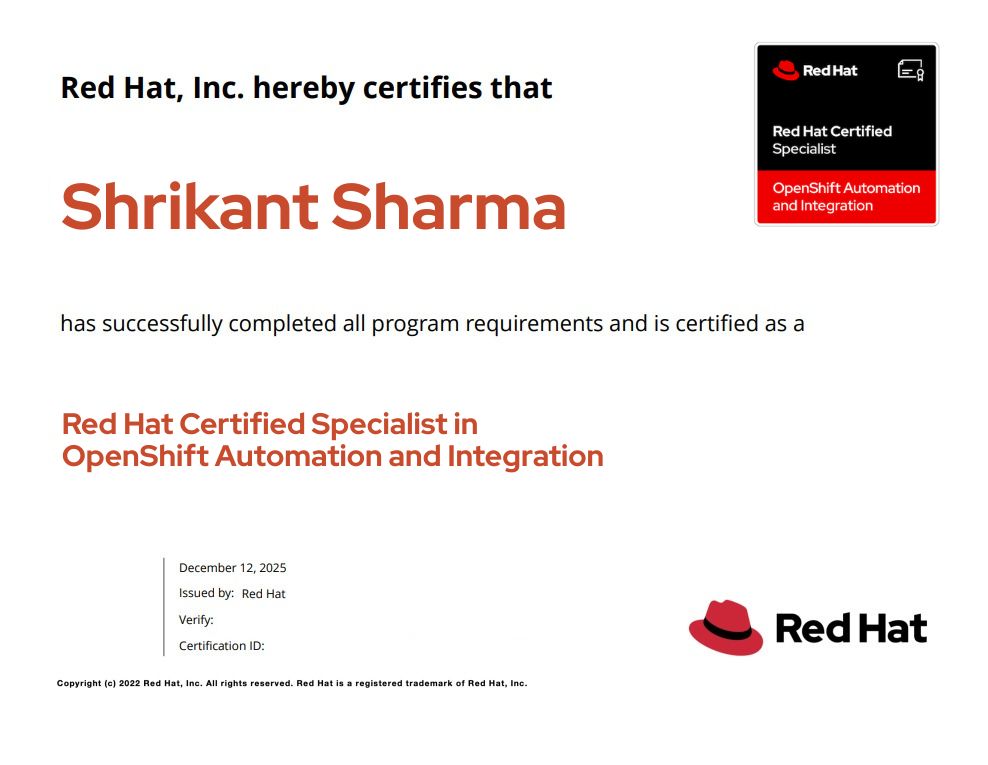
    This training also supports EX380 exam preparation, leading to the Red Hat Certified Specialist in OpenShift Automation and Integration certification. The delivery approach is aligned with performance-based exam expectations, making it suitable for professionals seeking DO380 training, EX380 training, and advanced OpenShift exam preparation

     

    Objective

    The primary objective of DO380 training is to enable professionals to confidently administer, automate, and troubleshoot enterprise OpenShift environments. By the end of the course, learners are expected to operate OpenShift clusters with a focus on scalability, security, reliability, and automation rather than basic day-to-day administration.

    Curriculum Highlights

    Key capability areas covered in DO380 training include:

    • Enterprise authentication and identity management using LDAP, OIDC, and certificate-based access
    • User, group, and RBAC management for multi-team OpenShift clusters
    • Application backup, restore, and migration using OpenShift API for Data Protection (OADP)
    • Advanced pod scheduling with node selectors, taints, tolerations, affinity rules, and pod disruption budgets
    • GitOps implementation for cluster configuration and application lifecycle management
    • OpenShift cluster monitoring, metrics, alerts, and performance analysis
    • Centralized logging, log forwarding, and troubleshooting using aggregated logs
    • Diagnosing and resolving cluster-level and application-level issues
    • Applying production-ready best practices for high availability and resilience

    Course Content

    Unit 1 - INTRODUCTION
    • Red Hat OpenShift Administration III: Scaling Deployments in the Enterprise
    • Orientation to the Classroom Environment
    • Performing Lab Exercises
    Unit 2 - AUTHENTICATION AND IDENTITY MANAGEMENT
    • The OpenShift OAuth Server and Identity Providers
    • LDAP Authentication and Group Synchronization
    • OIDC Authentication and Group Claims
    • Token and Client Certificate Authentication with kubeconfig Files
    • Lab: Authentication and Identity Management
    Unit 3 - BACKUP, RESTORE, AND MIGRATION OF APPLICATIONS WITH OADP
    • Export and Import Application Data and Settings
    • OADP Operator Deployment and Features
    • Backup and Restore with OADP
    • Lab: Backup, Restore, and Migration of Applications with OADP
    Unit 4 - POD SCHEDULING
    • Pod Scheduling Concepts
    • Node Selectors and Taints
    • High Availability with Affinity Rules and Pod Disruption Budgets
    • Lab: Pod Scheduling
    Unit 5 - OPENSHIFT GITOPS
    • GitOps for Kubernetes
    • GitOps for Cluster Administration
    • GitOps for Application Management
    • Lab: OpenShift GitOps
    Unit 6 - OPENSHIFT MONITORING
    • Cluster Monitoring
    • Alerts and Notifications
    • Lab: OpenShift Monitoring
    Unit 7 - OPENSHIFT LOGGING
    • Log Forwarding
    • Centralized Logging
    • Lab: OpenShift Logging
    Unit 8 - COMPREHENSIVE REVIEW
    • Comprehensive Review
    • Lab: Cluster Administration

    What you need to know?

    Prerequisite for DO380 Training

    This is an advanced OpenShift administration course and is not suitable for beginners.

    Prerequisites:

    1. Completion of Red Hat OpenShift Administration II (DO280) or equivalent hands-on experience
    2. Practical knowledge of OpenShift cluster operations, networking, storage, and application deployment.

    Why Learn Red Hat OpenShift Administration III (DO380)?

    Organizations running Red Hat OpenShift Administration in production require administrators who can manage complexity at scale. DO380 training helps professionals move beyond routine operations and develop enterprise-level skills such as automation, resilience planning, and proactive monitoring.

    This course is valuable for those who want to:

    • Reduce manual cluster operations through GitOps and automation
    • Improve reliability and recovery strategies for business-critical applications
    • Prepare for advanced OpenShift certifications such as EX380
    • Transition into platform engineering or SRE-focused roles
    • Gain hands-on experience with enterprise OpenShift use cases

    Audience for This Course

    DO380 training is intended for:

    1. OpenShift Cluster Engineers managing production environments
    2. Platform Engineers responsible for automation and standardization
    3. Site Reliability Engineers (SREs) focused on availability and performance
    4. DevOps and Platform Operations teams supporting CI/CD pipelines
    5. Cloud and Infrastructure Administrators working with Kubernetes platforms

    Are You Eligible for the OpenShift EX380 Exam?

    You are a suitable candidate for the EX380 exam if you:

    1. Have completed DO280 or possess equivalent OpenShift administration experience
    2. Regularly manage OpenShift clusters or containerized applications
    3. Are comfortable performing hands-on administrative and troubleshooting tasks
    4. Are preparing for advanced OpenShift or enterprise Kubernetes roles
    5. DO380 is one of the officially recommended trainings for preparing for the EX380 exam.

    EX380 EXAM DETAILS

    Certificate ProviderRed Hat
    Exam CodeEX380
    Exam NameRed Hat Certified Specialist in OpenShift Automation and Integration exam

    Exam TypePractical Lab Based
    Exam FormatOnline Proctored
    Exam LocationRemote basis or Official Testing center (e.g KR Network Cloud)
    Number of QuestionsAround 7
    Exam Duration240 Minutes or 4 Hours
    Maximum Score300
    Minimum Passing Score210
    Certification Validity3 Years
    Exam Attempt Validity365 Days after booking your exam (May vary with current policy)
    Exam Price20K+18% GST (May vary with Region & Current Pricing)

    EX380 Exam Focus Area:

    1. OpenShift authentication and identity integration
    2. LDAP and OIDC configuration
    3. Application backup and restore using OADP
    4. Advanced pod scheduling and workload isolation
    5. GitOps-based cluster and application management
    6. Monitoring, alerting, and centralized logging
    7. Troubleshooting OpenShift clusters and applications

    The exam evaluates practical ability rather than theoretical knowledge

    Career Opportunities After This Course

    After completing DO380 training and achieving EX380 certification, professionals commonly pursue roles such as:

    1. OpenShift Platform Engineer
    2. Kubernetes Site Reliability Engineer (SRE)
    3. DevOps Engineer
    4. Cloud Infrastructure Engineer
    5. Enterprise Container Platform Administrator

    These roles are in demand across organizations adopting cloud-native and Kubernetes-based platforms.

    Recommended Next Step After This Course

    After completing DO380, learners are encouraged to:

    1. Attempt the EX380 certification exam
    2. Apply automation and GitOps practices in live production environments
    3. Contribute to platform design and reliability initiatives
    4. Progress toward advanced Red Hat certification tracks

    Official Recommended Path

    The official learning progression for enterprise OpenShift administration is:

    1. Red Hat OpenShift Administration I
    2. Red Hat OpenShift Administration II (DO280)
    3. Red Hat OpenShift Administration III: Scaling Deployments in the Enterprise (DO380)
    4. EX380 – Red Hat Certified Specialist in OpenShift Automation and Integration
    The Top Reason why to choose KR Network Cloud

    • KR Network Cloud is the Red Hat Authorized Training Partner
    • Certified & Experienced Red Hat Trainers
    • Fully Equipped Labs & Hands-on Practice
    • Red Hat Training and Red Hat Certification Guidance
    • KR Network Cloud will provide you with the Notes, Videos, and Red Hat Training books
    • We provide Corporate & Industrial Training Expertise in Delhi
    • Demo Sessions, Backup Classes Available, Practice sessions, etc.
    • Dedicated Exam Preparation Support
    • Our trainer will also help to crack your interview.
    • Job assistance facility for our students is also available
    • Provides online as well as classroom training.
    • More Career Growth Opportunities for future

    Certificate